The most important Dholera SIR updates of 2026 — airport trials, Tata semiconductor SEZ notification, ₹610 crore Gujarat Budget allocation, and what it all means for plot investors.
Dholera SIR has been a fixture in investment conversations for years. But 2026 is different — not because of promises, but because of execution. The airport has crossed into its operational trial phase. India's first semiconductor fab has its SEZ formally notified. The Gujarat Budget has ring-fenced ₹610 crore specifically for Dholera's trunk infrastructure. And a second chip plant — focused on silicon carbide power semiconductors — has quietly broken ground.
If you've been watching Dholera and waiting for proof that the project is real, this is the update you've been waiting for.
Key Takeaways
- Dholera International Airport Phase 1 construction completed December 2025; calibration
flights ran January–February 2026, with full operational trials ongoing
- Tata's ₹91,000 crore semiconductor fab SEZ formally notified by the Government of India
on April 9, 2026 — the first chip-focused SEZ in India
- Gujarat Budget 2026–27 allocated ₹610 crore for Dholera SIR trunk infrastructure as
part of Phase 1 expansion
- Over 15 ancillary supply-chain companies have started land leveling near the Tata fab site
- Plot prices in the activation zone have stabilised after the initial Tata announcement
spike — analysts expect the next surge when airport commercial operations begin
The Airport Is No Longer a Future Promise
For most investors tracking Dholera, the airport has been the single most-watched indicator. Here is exactly where it stands as of mid-2026.
Phase 1 civil construction was completed in December 2025. The 3,200-metre Code 4E runway — capable of handling wide-body jets including Boeing 777 and Airbus A380 — is structurally finished and ready for use. Calibration flights took place between January and February 2026, with full operational trials scheduled for March onwards.
The passenger terminal structure is complete. The cargo handling facility is in place. The Air Traffic Control tower has been built.
Full passenger operations for Phase 1 are expected by December 2026, though this date has not been officially confirmed by AAI as of March 2026. Treat that as a target, not a guarantee — but the structural work is done.
The ownership structure is worth knowing for credibility purposes: Dholera International Airport Company Limited (DIACL) is a joint venture where AAI holds 51%, the Government of Gujarat holds 33%, and NICDIT holds the remaining 16%. This is a government-majority entity, not a private developer.
Why this matters for investors: Airports are proven catalysts for land appreciation in surrounding zones. Commercial logistics operations were the intended first-phase revenue source for the airport precisely because they require fewer regulatory approvals than passenger flights. Once cargo operations formally commence, the ripple effect on industrial plot demand — and by extension on residential plot prices in adjacent sectors — is expected to be significant.
The Semiconductor SEZ: What Actually Happened in April 2026
This is the single most important structural development Dholera has seen since the initial Tata Electronics announcement.
As per a gazette notification issued on April 9, 2026, the central government formally notified a 66.166-hectare SEZ located in Gujarat's Dholera Special Investment Region (SIR). The zone is earmarked for semiconductor manufacturing and related electronics activities. Approval was granted under the Special Economic Zones Act, 2005.
Tata Semiconductor Manufacturing has proposed an investment of ₹91,000 crore to establish what would be India's first chip fabrication unit. The SEZ is expected to generate 21,000 jobs.
The fab will manufacture semiconductors for HPC, EV power management, automobiles, defense, and consumer electronics, with a capacity of 50,000 wafers per month at a 28nm manufacturing process node, in collaboration with PSMC, Taiwan.
A notable operational detail: the SEZ has also been designated as an Inland Container Depot (ICD) under the Customs Act, 1962, effective April 9, 2026. This means customs clearance can happen on-site — a major advantage for semiconductor supply chains where components are imported and finished chips are exported under tight timelines.
To understand the policy depth behind this: Gujarat was India's first state to implement a dedicated semiconductor policy in 2022, and no other state has matched it as of 2026. The incentive stack includes a 75% land acquisition subsidy, 40% capital expenditure subsidy, 100% stamp duty refund, and an ₹2/unit electricity subsidy. For a ₹91,000 crore project, that 40% capex subsidy alone translates to over ₹36,000 crore in direct government support.
There is also a second chip plant, less discussed but significant: NextGen Semiconductors chose Dholera for India's first silicon carbide power chip plant. Dholera is now the only location in India with two chip manufacturing facilities confirmed.
Gujarat Budget 2026–27: ₹610 Crore for Dholera Infrastructure
Government budget allocations are often overlooked in investment analysis. They shouldn't be — they signal where execution is actually headed.
Finance Minister Kanubhai Desai allocated ₹610 crore for trunk infrastructure development at Dholera SIR in the Gujarat Budget 2026–27. Trunk infrastructure in a planned city context means the backbone systems: arterial roads, water supply networks, underground utility corridors, power distribution, and drainage systems that all subsequent development plugs into.
This investment forms part of Phase 1 of a broader infrastructure program and focuses on essential industrial enablers, including integrated infrastructure critical for semiconductor manufacturing, which depends on uninterrupted power, reliable utilities, and advanced logistics systems.
At the national level, the Union Budget 2026 launched India Semiconductor Mission 2.0, with the Electronics Components Manufacturing Scheme expanded to ₹40,000 crore. Dholera, as the site of the flagship Tata fab and its formally notified SEZ, sits at the centre of this national push.
What this means in plain terms: both the state and central governments are actively spending real money on the infrastructure that makes Dholera's industrial zones functional. This is not announcement-stage policy — it is budget-line execution.
On-the-Ground Industrial Activity: What's Happening at the Tata Site
Policy announcements are one thing. What's actually happening on the ground is another.
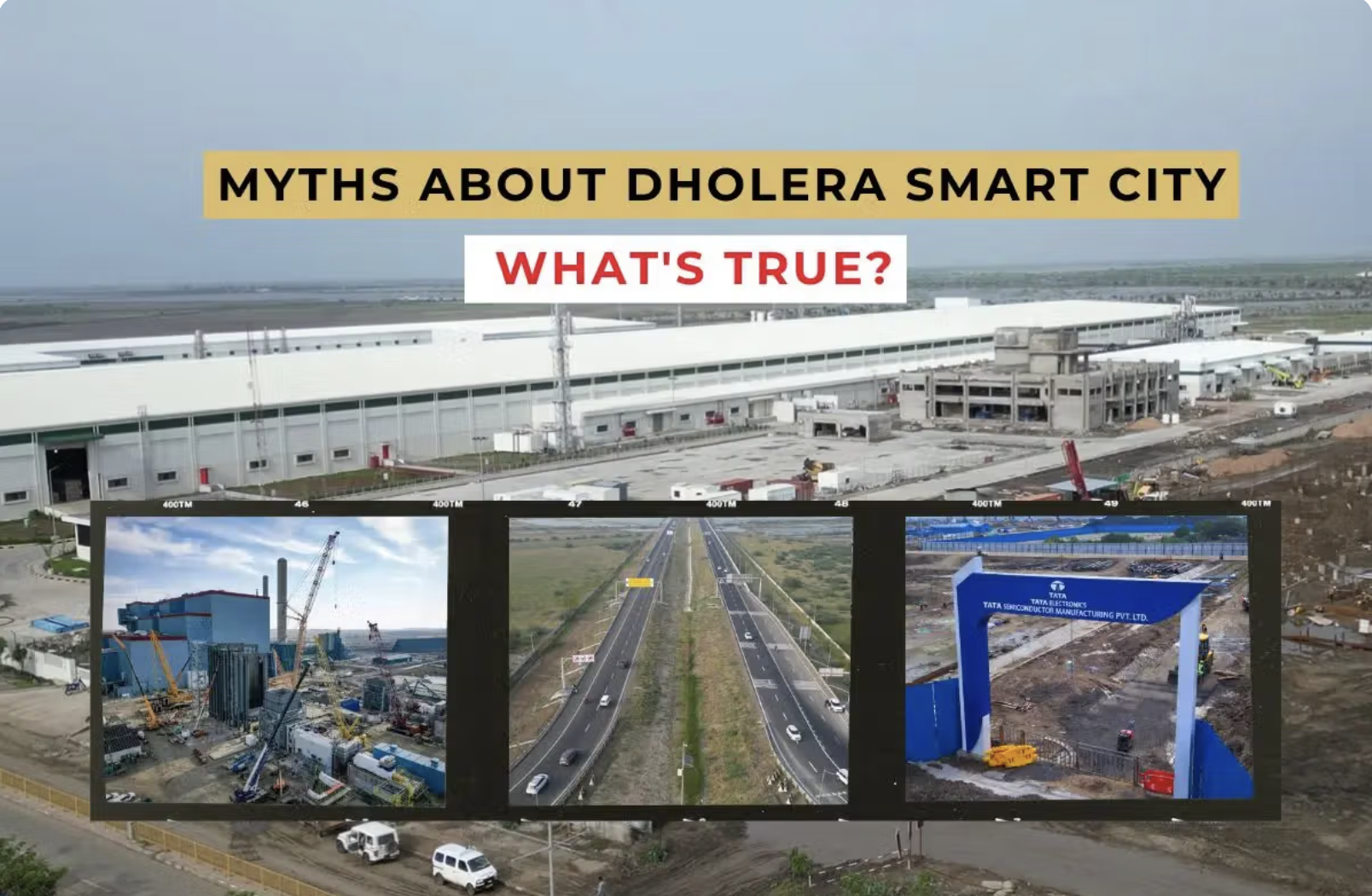
The massive structural work for India's first AI-enabled semiconductor fab is complete. Cleanroom installation and machinery move-in have started. Over 15 supply-chain companies, including Japanese and Taiwanese firms, have started land leveling for their units near the Tata site. Over 5,000 workers and engineers are currently active on-site in the industrial zones.
This is the cluster effect in action. When a major anchor tenant commits to a location, ancillary suppliers follow. Packaging facilities, precision equipment servicing companies, specialty chemical suppliers, and logistics operators all need to be physically proximate to a fab. Each of these companies needs industrial land. Each of them brings employees who need housing. The residential plot demand case for Dholera is downstream of exactly this kind of industrial activation.
As of April 2026, Tata's fab construction is approximately 50% complete across the 66.2-hectare site. The ASML partnership — announced during PM Modi's Netherlands state visit on May 16, 2026 — added further global credibility: ASML manufactures the lithography machines that produce semiconductor chips, and their involvement signals that Dholera's fab will operate with world-class equipment.
Ahmedabad–Dholera Expressway and Railway: The Connectivity Picture
Infrastructure investment in real estate is ultimately about accessibility. Dholera's connectivity story has two chapters in 2026.
The Ahmedabad–Dholera Expressway is in advanced stages of completion. The expressway's strategic location will reduce travel time from Ahmedabad to under an hour, improving access for industries, travelers, and logistics players alike. The expressway is expected to be inaugurated alongside the cargo terminal launch — a coordinated rollout that creates immediate multi-modal connectivity for the region.
The railway story is newer and worth tracking. In January 2026, the survey work for connecting Ahmedabad with Dholera through rail moved ahead. The proposed route will play a key role in connecting industries, workers, and residents. Rail connectivity is not imminent, but the survey phase moving forward is meaningful — surveys precede engineering design, which precedes tendering and construction. The process has started.
The connectivity logic for plot investors is straightforward: land near infrastructure nodes appreciates faster than land in infrastructure-poor zones. Dholera's activation zone — the area with completed trunk infrastructure, operational services, and proximity to the expressway and airport — is where this appreciation will be most pronounced first.
What This Means for Plot Buyers in 2026
Let's address the question directly: given all of this, where does Dholera stand as an investment in mid-2026?
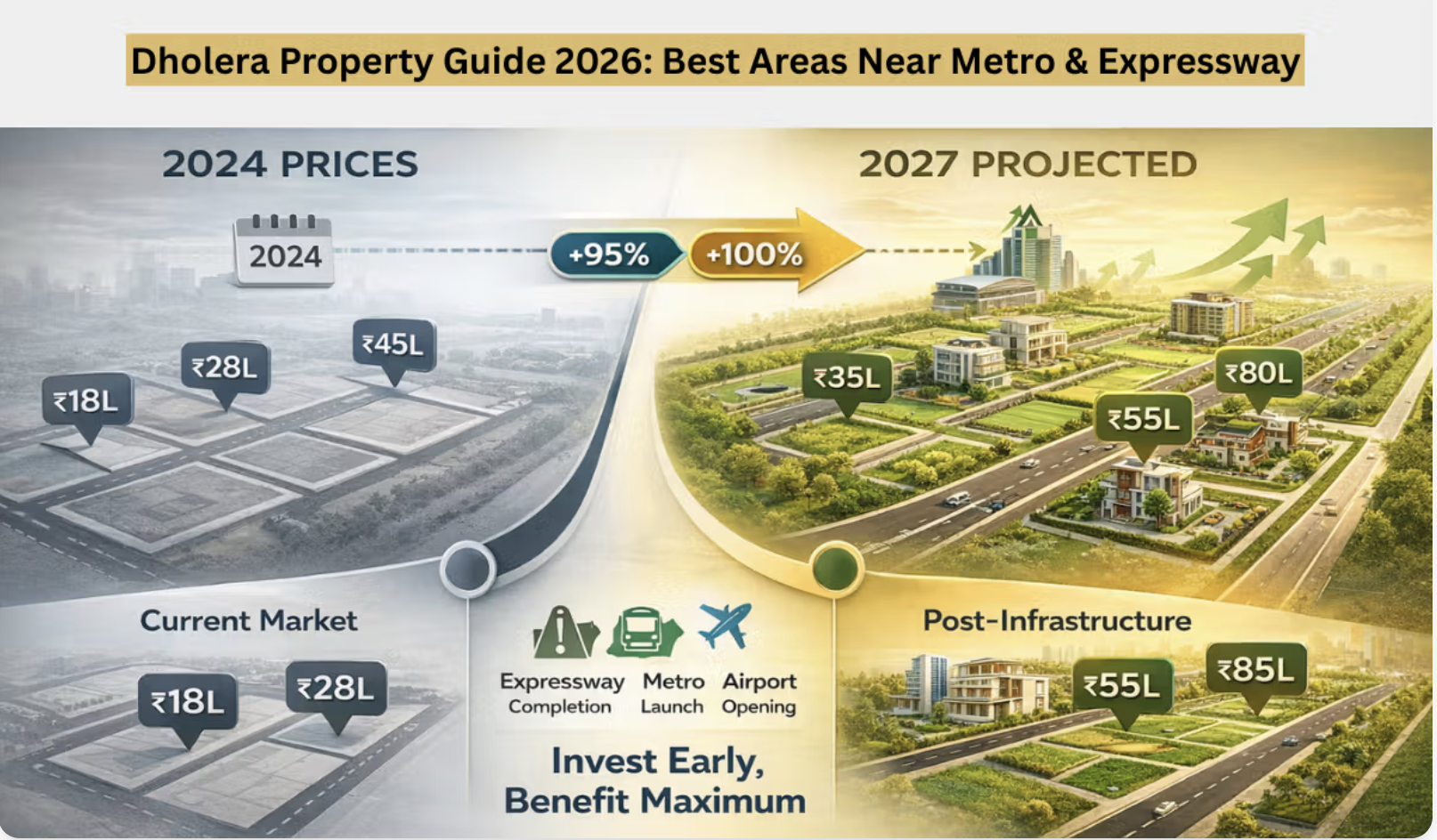
Land prices have stabilised after the initial Tata announcement spike but are expected to surge again once the airport becomes operational. This is the pattern around large infrastructure projects globally — a spike on announcement, consolidation during construction, and a second sustained rise once operations begin. Dholera is currently in that consolidation window.
The risk profile has genuinely changed. The current status of Dholera shows that the activation area's trunk infrastructure is fully operational. Major milestones, including the international airport's runway completion and the Ahmedabad-Dholera Expressway, are now driving rapid industrial occupancy and significant residential plot investments across the region.
This is materially different from what first-time investors were buying into in 2021 or 2022, when Dholera was primarily a bet on future government execution. In 2026, you can see the runway. You can see the fab under construction. You can see the expressway taking shape. The risk has moved from "will this happen" to "when will it fully come online."
What has not changed: the legal checklist every buyer must run before purchasing any Dholera plot. NA (Non-Agricultural) certification confirming the land is legally converted for non-agricultural use. NOC clearance for the developer's project (this category of plotted land is not required to be RERA-registered). Town Planning (TP) scheme sanction. Clear title verified through proper due diligence. With the city becoming active, fake plot scams by unregistered agents have increased. The pace of development is drawing bad actors alongside genuine opportunity. Work only with verified, NA/NOC-certified developers and insist on complete documentation before any payment.
Frequently Asked Questions
Is Dholera International Airport open yet? Not for commercial operations as of June 2026. Phase 1 construction completed in December
- Calibration and operational trials are underway. Cargo operations and passenger
services are being progressed in phases, with full Phase 1 operations targeted by late 2026.
What is the Dholera semiconductor SEZ and why does it matter? The Government of India formally notified a 66.166-hectare Special Economic Zone in Dholera on April 9, 2026, specifically for Tata Semiconductor Manufacturing's ₹91,000 crore chip fabrication facility. It is India's first chip-focused SEZ. The zone also carries Inland Container Depot status, enabling on-site customs clearance. This is the single most significant industrial approval Dholera has received.
How much has Gujarat allocated to Dholera in its 2026 budget? ₹610 crore for trunk infrastructure development in Dholera SIR, focused on Phase 1 industrial enablers including roads, water supply, power, and utilities.
Is it safe to buy a plot in Dholera right now? The infrastructure risk — whether the project would actually happen — has substantially reduced. The legal risk of buying from unverified sellers has increased as the region attracts more unregistered agents. Always verify NA certification, NOC status (RERA registration does not apply to this category of plotted land), TP scheme sanction, and clear title before committing to any purchase.
When is the best time to buy a Dholera plot? Prices are currently in a consolidation phase following the Tata announcement spike. The next significant appreciation trigger is expected when airport commercial operations commence. Buyers entering before that trigger historically capture stronger returns.
Dholera in 2026 is a different city from Dholera in 2022. The runway is built. The fab is half constructed. The SEZ is formally notified. The budget allocation is in the books. The expressway is nearly complete. These are not projections — they are facts on the ground.
If you've been evaluating Dholera from a distance, this is a good moment to look more closely.
Talk to a DealWithIt advisor — no pressure, just clarity. We'll walk you through verified available plots in the activation zone, current pricing, and the exact legal checks you need to do before you sign anything. [Get in touch with DealWithIt today.]