Compare Dholera TP schemes, zones and projects — rates, infrastructure status, and a 10-point scorecard to grade any project before you buy.
Nobody wants to visit five project websites, sit through five sales calls, and still not know which one is right. So here is the comparison in one place.
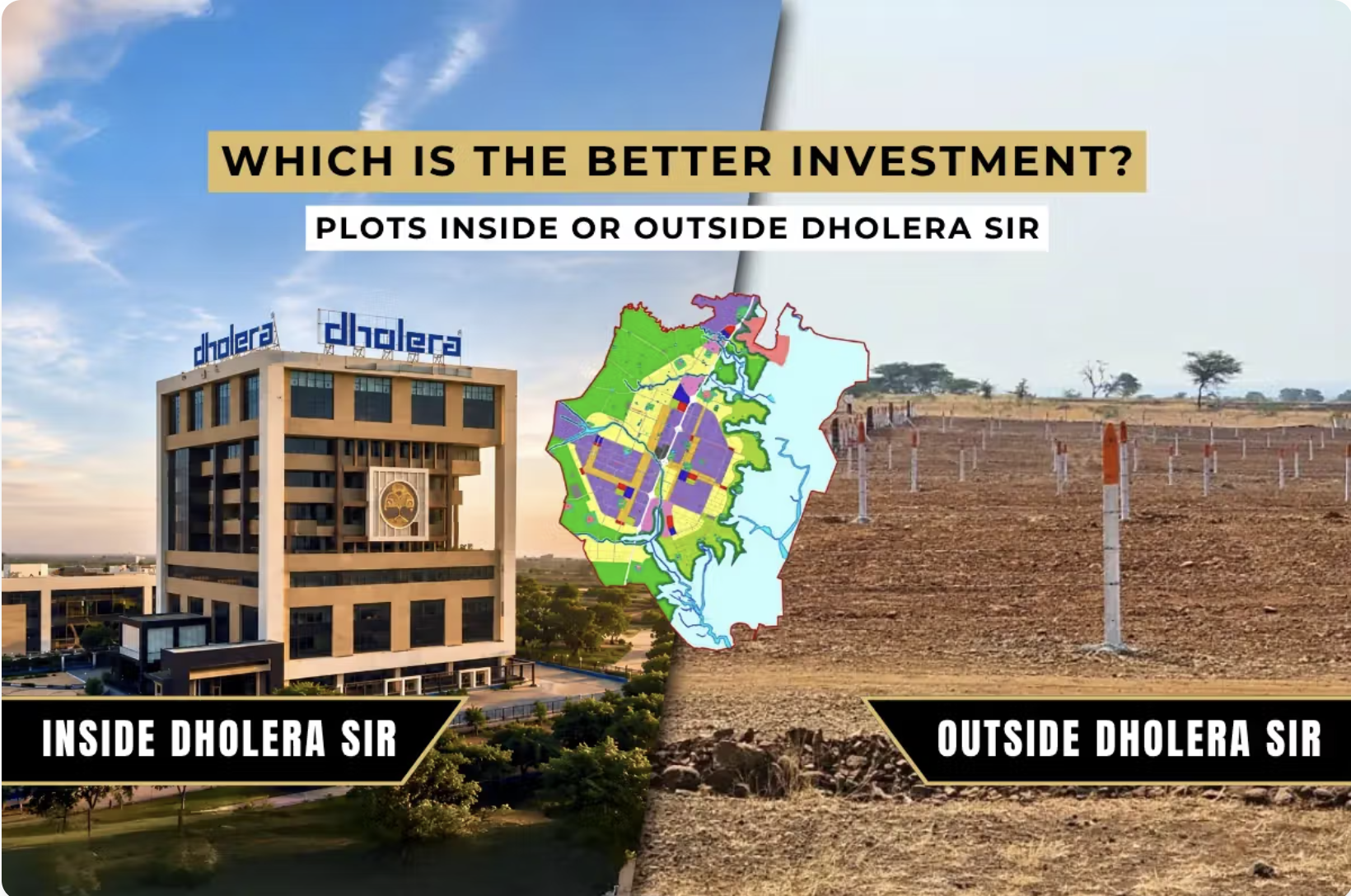
But we have to start with something most comparison pages skip: in Dholera, the project matters less than the zone it sits in. Two projects with identical brochures, identical clubhouses and identical promises can be worth wildly different amounts in ten years, purely because one sits inside a serviced TP scheme and the other sits in a village 900 metres outside the SIR boundary.
So this page compares zones first, then gives you a scorecard to grade any project — including ours — against the same standard.
Key Takeaways
- Dholera is not one market. It is at least four: inside-SIR serviced zones, inside-SIR unphased zones, near-SIR private layouts, and far-periphery agricultural land sold as "Dholera."
- TP1 and TP2 (Activation Area) carry the highest prices and the lowest execution risk.
- TP3 and TP4 near the airport carry lower prices and a longer, more uncertain wait.
- Near-SIR private townships offer earlier possession and construction rights, but no DSIRDA trunk infrastructure.
- The single biggest price driver is inside SIR vs. near SIR — not the developer's brand.
First: The Four Markets Being Sold as "Dholera"
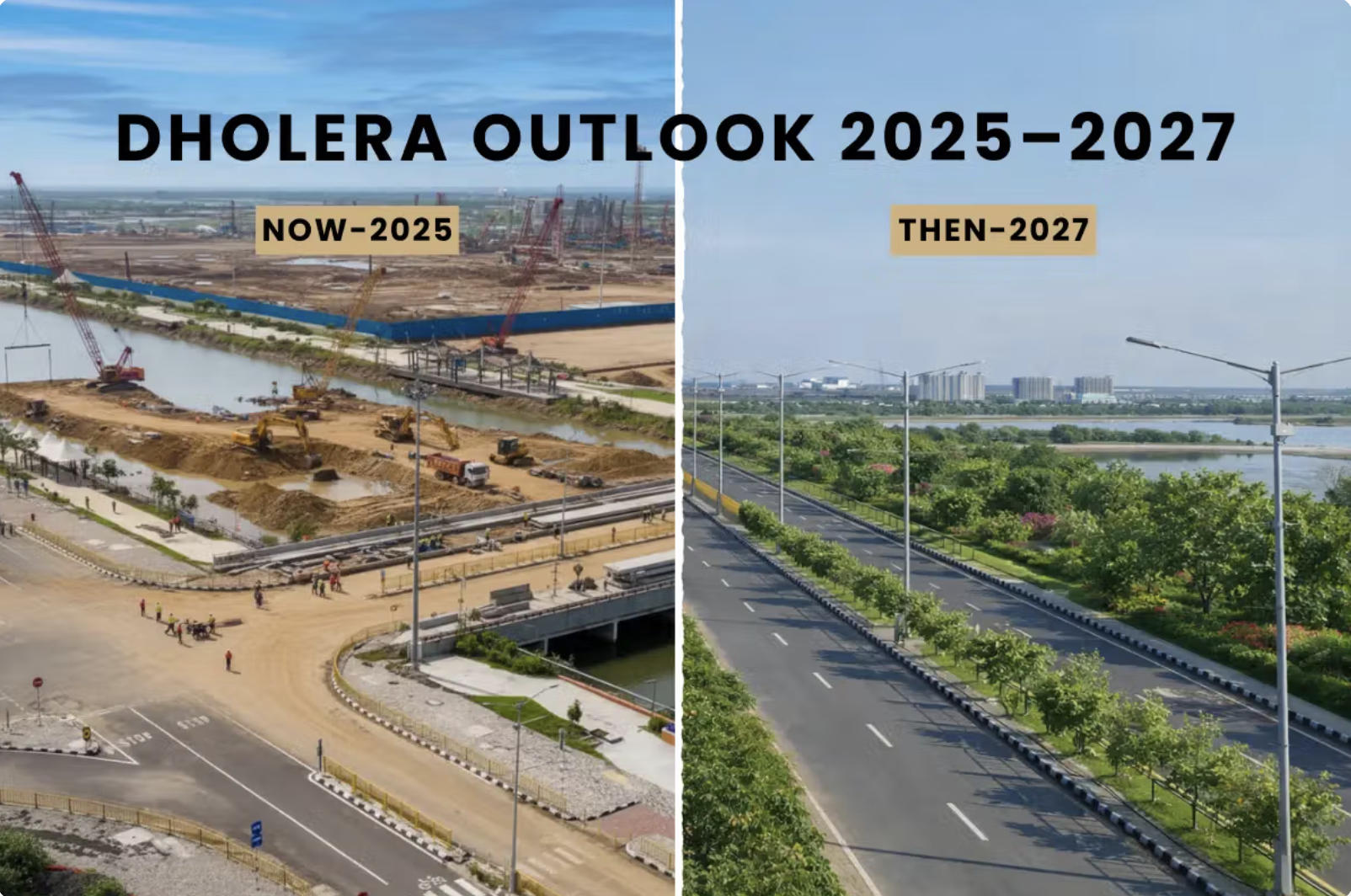
Dholera Special Investment Region spans roughly 920 sq km, but only about 22.54 sq km — the Activation Area — has completed trunk infrastructure. Everything marketed as "Dholera" falls into one of four buckets, and they are not the same asset.
| Market | What It Is | Typical Rate (₹/sq yd) | Real Risk | |---|---|---|---| | Inside SIR — serviced (TP1, TP2) | Reconstituted final plots on completed roads, utilities, ICT | ₹10,500 – ₹22,000 | Lowest. Priced accordingly. | | Inside SIR — unphased (TP3–TP6) | Final plots allotted, infrastructure phased over years | ₹7,000 – ₹14,000 | Timeline risk. Could be a long wait. | | Near SIR — private layouts | Gated townships just outside the boundary, individual titles | ₹6,000 – ₹9,000 | No DSIRDA infrastructure. Ever. | | Far periphery — agricultural | Raw land marketed on the Dholera name | ₹5,000 and below | Highest. Often no NA, no plan approval. |
Rate ranges are indicative, compiled from multiple public listings and market reports across 2026. They move constantly and vary by plot size, road frontage and corner premium. Treat them as a sanity check on a quote, not as a price list.
The most important sentence on this page: a cheap plot outside the SIR is not a discount on a Dholera plot. It is a different product.
TP Scheme Comparison
Dholera SIR is divided into six Town Planning schemes. This is the decision that actually determines your outcome.
| TP Scheme | Character | Infrastructure Status | Indicative Rate | Best For | Honest Downside | |---|---|---|---|---|---| | TP1 | Residential heart, closest to ABCD Building | Roads and underground utilities complete | ₹11,000 – ₹16,000 | Long-term residential, build-ready | Already repriced. Limited inventory. | | TP2 (Activation Area) | Premium serviced zone, commercial + industrial | Trunk infrastructure substantially complete | ₹10,500 – ₹22,000 | Lowest execution risk | Highest entry price in the SIR | | TP2 (A & B) expressway edge | High Access Corridor, commercial zoning | Infrastructure underway | ₹10,000 – ₹18,000 | 3–5 year commercial holds | Not yet fully serviced | | TP3 | Airport-adjacent, logistics and tourism | Phased | ₹7,000 – ₹14,000 | 5+ year horizon | Everything depends on the airport | | TP4 | Airport cargo side, mixed-use | Phased | ₹7,000 – ₹14,000 | Patient capital | Longest wait of the inside-SIR options | | TP5 / TP6 | Outer schemes | Early | Varies widely | Speculative only | Verify everything twice |
How to read this table: the price gap between TP1 and TP4 is not a bargain. It is the market accurately pricing the difference between "your road exists" and "your road is scheduled."
The Project Scorecard
Forget brochures. Grade any project — ours included — on these ten questions. Each one is a yes or no. If you cannot get a written yes, score it zero.
Legal and Status (non-negotiable)
- Is the plot inside the notified SIR boundary? Not "near." Not "on the Dholera corridor." Inside. Verify the survey number against the official boundary.
- What is the exact TP scheme and final plot number? A project that answers "TP1 area" instead of a final plot number is answering a different question.
- Is NA certification in place and visible in official records? In Gujarat, land must be NA-converted for residential or commercial use. The survey number should reflect the conversion in AnyRoR. Verbal NA claims are worth nothing.
- Is the plot NOC-cleared and NA-certified? This category of plotted land in Dholera SIR is not required to be RERA-registered — NA certification and NOC clearance are the applicable documents. Treat an unverifiable RERA-registration claim (where none applies) as a red flag, the same way you'd treat any other unverifiable document.
- Can your own lawyer inspect the original 7/12 and 8A documents? Not scans. Originals. Hesitation here is the answer.
Infrastructure and Delivery
- What infrastructure is committed in writing, with a date? Roads, water, drainage, power. Verbal phasing commitments do not underwrite a ten-year hold.
- Are internal roads and plot demarcation already on the ground? Go and look, or send someone.
- Is the plot's zoning aligned with your intended use? Residential zoning for a residential plan. A zoning change is not a formality.
Commercial
- Is the quoted rate per sq yd or per plot? This trips up more first-time buyers than any other single thing.
- What is the jantri rate for this survey number? Stamp duty in Gujarat is charged at 4.9% on the higher of jantri or agreement value. If jantri exceeds your agreed price, you pay the difference. Verify on the GARVI portal before you commit.
Scoring: 10/10 is the only passing grade on questions 1–5. Those are not preferences. On 6–10, anything below 4 means you are buying a story.
Why We Don't Publish a Competitor Price Table
You may have expected a row-by-row table of named private projects with their prices.
We don't publish those, for one reason: we can't verify them. Private project rates change monthly, vary by plot size and frontage, and are frequently quoted as "starting from" figures attached to inventory that is already gone. A table of numbers we scraped from five brochures would look authoritative and mislead you.
What we do instead: we publish the zone ranges above so you can sanity-check any quote you're given, and we publish the scorecard so you can grade any project on the things that don't change month to month — boundary, TP scheme, NA status, NOC clearance, written infrastructure commitments.
If a comparison page tells you Project A is better than Project B without telling you which TP scheme each sits in, it isn't a comparison. It's an advertisement with a table in it.
Which Should You Choose? Three Honest Profiles
If you want the lowest risk and can afford it → TP1 or TP2. The infrastructure exists. You are paying for that certainty. Appreciation from here depends on industrial occupancy, not on whether roads get built.
If you have a 7–10 year horizon and want more upside → TP3 or TP4, airport-adjacent. You are underwriting the airport hitting operations and the fab reaching commercial production. Both are plausible. Neither is certain. Size the position accordingly.
If you want to build a house soon on a smaller budget → near-SIR private layout, with eyes open. You get earlier possession and independent construction rights without waiting on TP reallotment. You do not get DSIRDA trunk infrastructure, and you should never be sold one as if it were the other.
Who Should Not Buy Any of These
If you need the money back inside 24 months, none of these work. Land in Dholera is illiquid. The catalysts that move it — airport operations, fab production, rail — sit between late 2026 and 2031. If a seller tells you otherwise, that is the moment to leave.
If you cannot personally visit or send a trusted person to the site, add a discount for that. Brochures are the most beautiful thing in Dholera.
Related Reading
Check the current status of every project driving these prices in our Dholera infrastructure tracker, see the decade-long rate history in the Dholera price index, and read the myths we've fact-checked before your first site visit.
Frequently Asked Questions
Which TP scheme is best in Dholera? TP1 and TP2 carry the lowest execution risk because trunk infrastructure is substantially complete there, and their prices reflect that. TP3 and TP4 near the airport are cheaper with more upside and a longer, less certain wait. There is no universally best scheme — only the one that matches your horizon and risk tolerance.
Is it better to buy inside the SIR or near the SIR? They are different products, not better and worse. Inside the SIR you get DSIRDA trunk infrastructure, TP-scheme final plots and higher FSI, at a higher price. Near the SIR you get an individual title, earlier possession and construction rights, at a lower price, with no smart city infrastructure. The mistake is paying inside-SIR prices for a near-SIR plot.
What is the difference between an original plot and a final plot? Under the Town Planning scheme process, landowners pool their original plots (OP), the authority takes a share for roads and public use, and returns a reconstituted final plot (FP). Buyers transact on final plots. Proper title diligence traces the chain back from the FP to the OP.
How do I verify a Dholera project is genuine? Verify the survey number sits inside the notified SIR boundary, confirm the TP scheme and final plot number, check NA conversion in official AnyRoR records, confirm NOC clearance with the developer, and have your own lawyer inspect original 7/12 and 8A documents. Never rely on a brochure or a scanned copy.
Do Dholera plots need RERA registration? No — this category of plotted land in Dholera SIR is not required to be RERA-registered. What applies instead is NA certification and NOC clearance, which every genuine project should be able to document. Verify these directly with the developer and through official land records, not on the strength of a brochure claim.
What price should I expect to pay in Dholera in 2026? Roughly ₹10,500–₹22,000 per sq yd in serviced inside-SIR zones, ₹7,000–₹14,000 in phased inside-SIR zones, and ₹6,000–₹9,000 for near-SIR private layouts. These are indicative and move constantly. Use them to sanity-check a quote, never as a substitute for a current written offer.
Why don't you list competitor project prices? Because we can't verify them, and publishing unverifiable numbers in a clean-looking table would mislead you. We publish zone ranges you can check a quote against, and a scorecard that grades the things that actually determine outcomes.
Get the Zone Right Before You Get the Plot Right
The scorecard above is the same one we run internally before we put a plot in front of anyone. If you'd like us to run it on a project you're already considering — even one that isn't ours — send us the details.
Talk to a DealWithIt advisor. No pressure, just clarity. We'll tell you which TP scheme it sits in, whether it's inside the boundary, and what the honest holding period looks like.
Book a free consultation with dealwitit· [Explore verified Dholera plots
Written by the DealWithIt research team. We broker Dholera SIR plots and have guided first-time buyers through the SIR since its early phases. Rate ranges on this page are compiled from public listings and market reports and are indicative only. Verify every figure against a current written offer and official records before committing funds.