Is Dholera a good investment in 2026? We look at the real infrastructure progress, land price data, the Tata semiconductor fab, the risks no one talks about, and who this investment actually suits.
Introduction
If you've been researching Dholera, you've probably seen two kinds of content. One type treats it as a guaranteed goldmine — "prices will 10x by 2030," "India's Shenzhen," "the best investment of the decade." The other type raises vague fears without specifics — "project delays," "it's been going on for years," "nobody lives there yet."
Neither is particularly useful if you're a first-time buyer trying to make a real decision with real money.
So here is the honest version. Is Dholera a good investment in 2026? The answer is: yes, for the right kind of investor — and no, for everyone else. The line between those two groups is more specific than most content lets on, and this post draws it clearly.
We'll look at what's actually built, what the price data shows, what the risks genuinely are, and — most importantly — who this investment actually suits before you spend a rupee.
What Has Actually Been Built: The Ground Reality in 2026
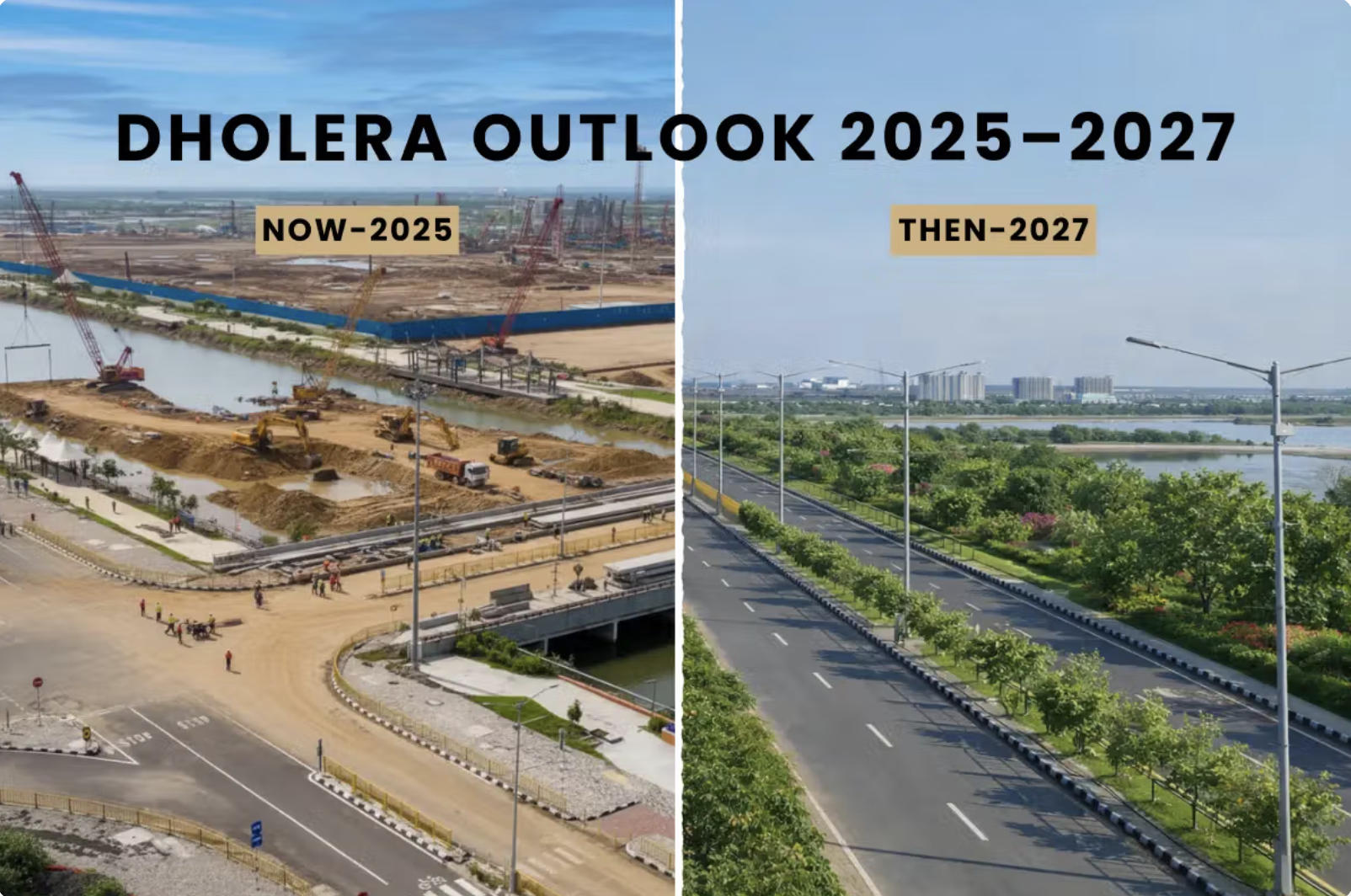
The most important shift in 2026 is that Dholera has moved from a plan with progress to a project with tangible, visible infrastructure. That distinction matters enormously for investor risk.
The Activation Area: 22.5 sq. km, Infrastructure Complete
The Activation Area — also called TP2 West — is the initial 22.5 square kilometre launch zone of Dholera SIR. As of 2026, it is infrastructure-complete. Over ₹3,000 crore has been invested here. Wide roads are laid. Underground utilities — water, power, gas, ICT fibre — are installed. The ABCD Building (Administrative, Business, Convention, Display), Dholera's landmark government hub, is operational. Smart sensors, underground cabling, and 24/7 water and power supply are in place.
This is not a render or a future plan. It is a built, functional zone — the only place in India where a factory can genuinely plug in and start operations with zero infrastructure wait.
The Expressway: Operational
The 109-kilometre Ahmedabad-Dholera Expressway is operational. It cuts travel time between Ahmedabad and Dholera to approximately 45 minutes. This single piece of connectivity is what real estate analysts call the primary price catalyst for the region — accessibility directly determines land value, and the expressway has already closed the distance gap that kept Dholera speculative for years.
The Airport: Phase 1 Complete
Dholera International Airport Phase 1 civil works were completed in December 2025. Calibration flights ran January–February 2026. The runway can handle wide-body jets. The passenger terminal structure and ATC tower are built. Cargo operations are expected to begin shortly, with passenger services to follow. The airport is no longer under construction — it is in its operational commissioning phase.
The Tata Semiconductor Fab: 50% Built
The ₹91,000 crore Tata Electronics semiconductor fabrication facility — in partnership with Taiwan's PSMC — is 50% complete as of April 2026. First chip production is targeted for December 2026. The Tata-ASML MoU was signed in May 2026 at PM Modi's Netherlands state visit. Over 20,000 direct and indirect jobs will be created in the Dholera region.
This is India's single largest semiconductor investment. Its presence in Dholera is not an MoU on paper — it is an active construction site.
What the Price Data Actually Shows
Price data is where investor conversations about Dholera most frequently get confused — either inflated by marketing or understated by sceptics. Here is what verified market data shows.
The Long-Run Picture
Plots that were priced at ₹1,000–₹1,500 per square yard a few years ago are now selling for ₹6,000–₹7,000 per square yard in older zones. In prime TP1 and TP2 areas near the expressway and Activation Area, current prices range from ₹8,000 to ₹15,000+ per square yard depending on proximity to key infrastructure.
One verified price history shows ₹325 per sq. ft. in July 2022 rising to ₹1,500 per sq. ft. today — documented history across multiple launched projects, not a projection.
The Recent Trend
Land prices in prime TP1 and TP2 schemes have risen at 18–25% year-on-year, driven by progress on the Ahmedabad-Dholera Expressway and the Tata semiconductor plant construction.
Entry-Level in 2026
As of 2025–2026, residential plot prices in Dholera typically range from ₹8,000 to ₹15,000 per sq. yard depending on zone, project, and proximity to key infrastructure. A typical residential plot of 100–150 sq. yards can start from around ₹8–12 lakh in developing locations.
What This Means
The "floor entry" window — where prices were purely speculative — has closed in prime zones. The market has matured. Investors are now paying for visible progress rather than just future promises. That is a healthy sign. It means prices have a floor grounded in real infrastructure rather than optimism alone. It also means the remaining appreciation window is driven by the next set of operational milestones — airport passenger operations, semiconductor fab production, and industrial workforce arrival — rather than by speculation on whether any of this will happen.
The 5 Strongest Arguments for Investing Now
- You Are Buying Ahead of the Operational Trigger
2026 represents a unique window where prices are still rational before the full explosion of value that comes with a fully operational airport and industrial ecosystem.
In every major industrial corridor globally — from South Korea's Ulsan to Taiwan's Hsinchu to India's own Noida along the Yamuna Expressway — the steepest appreciation happens in the 18–36 months after the anchor industry begins operations. Dholera's anchor (Tata semiconductor fab, first chips December 2026) is weeks away from that trigger. Investors who enter before the trigger pay pre-trigger prices. Investors who wait for proof pay post-trigger prices.
- Infrastructure Is Now Funded and Visible, Not Promised
The ₹610 crore Gujarat Budget 2026–27 allocation confirmed trunk infrastructure funding in a state budget — not a press release. The expressway is driven daily. The airport runway is complete. The ABCD Building is operational. This is not the same risk profile as 2018 or 2020, when scepticism about delivery was rational.
The risk profile has shifted. In 2026, the risk in Dholera has moved from "Will it happen?" to "How fast can I build?" That is a meaningful shift in the nature of what you are buying.
- Entry Prices Are Still Below Post-Operational Value
Land in the Activation Area and TP1 currently costs ₹13,000–₹22,000 per sq. yd. — significantly below what comparably developed industrial smart city land commands globally. For context, land near operational semiconductor clusters in other Asian economies trades at multiples of this. India is not those markets yet, but the gap is narrowing.
Plots that were sold at ₹200 per sq. ft. in 2020 are now fetching ₹500–700 per sq. ft. in 2026. The entry-level buyer who invested four years ago has already seen a 2.5–3.5x return. The question for 2026 buyers is what the next equivalent catalyst does to prices from here.
- Structural Demand — Not Speculative Demand — Is Building
Residential land inquiries in Dholera tripled in the first half of 2026. Developers are focusing on gated communities with smart features, anticipating the housing needs of the thousands of professionals moving to the region.
This is structural demand — actual workers being hired who will need housing — not speculative buying by investors hoping to flip to other investors. Structural demand is what sustains appreciation over a full market cycle. Speculative demand reverses. Structural demand does not.
- The Dual-Government Structure Reduces Project Risk
Dholera is not a private developer's project. It is owned and managed by DICDL — a joint venture between the Government of India and the Government of Gujarat. Both governments have budget allocations, public accountability, and political capital tied to this project's success. The DMIC framework adds a national industrial corridor layer on top of that. This structure is as insulated from abandonment as any infrastructure project in India can be.
The Honest Risks: What Nobody Tells You Clearly Enough
A trustworthy investment analysis has to address the downsides. Here are the real risks — not vague fears, but specific things that can go wrong.
Risk 1: Timeline Extensions Are the Historical Pattern
The project has faced delays at nearly every phase. What was projected to be operational by 2022 is still largely under development in 2026.
This is true and important. The airport was originally scheduled for an earlier date. The expressway took longer than initial projections. Industrial operations have not yet reached full scale. If you invest assuming a specific return by a specific year, delays will frustrate and potentially damage your financial plan.
The mitigation: invest with a 7–10 year horizon, not a 3–5 year one. With that horizon, delays of 1–2 years on any given milestone do not materially change the investment thesis.
Risk 2: Buying Outside the SIR Boundary Is a Different Investment Entirely
The primary disadvantages include a long gestation period requiring 5–10 year holding patience, current lack of daily social amenities like schools and malls, and the high risk of falling for fraudulent agricultural land schemes sold by unauthorized brokers outside the official SIR boundaries.
Plots outside the SIR boundary are cheaper. They are cheaper because they sit outside the planning and infrastructure framework that all of the above analysis applies to. They may never receive the roads, utilities, and connectivity that make Dholera plots valuable. Always verify that any plot you evaluate is inside the SIR boundary and within an approved TP scheme.
Risk 3: Missing Documentation Is a Buyer-Level Risk, Not a Project-Level One
NA certification, clear title, NOC clearance, and TP scheme sanction are not optional formalities. They are the legal foundation of your investment (this category of plotted land is not required to be RERA-registered — NA/NOC is the applicable framework). A plot without these documents is not a "discounted entry" — it is an unprotected position that can result in loss of capital with no legal recourse.
Investing in Dholera is extremely safe and lucrative if you buy land that is inside the official SIR boundary, NA/NOC-certified, and sanctioned under an active Town Planning scheme (TP1 to TP6). If you chase abnormally cheap rates in non-TP agricultural zones, your capital is at immense risk.
Risk 4: No Rental Income in the Near Term
Dholera currently offers negligible rental yield. Industrial plants are still under construction. Residential zones are in layout phase. If your investment plan requires income from the property — monthly rent, annual yield — Dholera is not the right asset for that goal. This is a capital appreciation play. Return comes from price increase over time, not from rental income while you hold.
Risk 5: Liquidity Is Not Guaranteed
Selling a plot in Dholera requires finding a buyer who shares your thesis. In the current market, liquidity is moderate and improving — more buyers are entering, and the resale market is active in prime zones. But this is not a stock you can exit in a day. Illiquidity is structural to this type of investment and must be factored into your planning.
Who Should Invest in Dholera in 2026 — and Who Should Not
This is the most practical section of this post. Read it carefully before deciding.
Dholera Is a Good Investment If:
You can hold for 5–10 years without needing the capital back Your budget is ₹10–30 lakh — enough for a 100–200 sq. yd. residential plot inside an approved zone You do not need rental income from this investment You are buying a plot that is inside SIR, NA-certified, NOC-cleared, and within an approved TP scheme You understand that appreciation is tied to measurable infrastructure milestones, not to general market sentiment You are working with a verified developer or registered broker who can provide documentation
Dholera Is Not a Good Investment If:
You need returns within 3–5 years You are counting on rental income to justify the investment You are looking at plots outside the SIR boundary because they are cheaper You are being offered a deal with guaranteed returns — no legitimate land investment guarantees specific returns You cannot afford to hold through a 1–2 year delay in any given milestone without financial stress You have not verified the plot's NA certification, title, and NOC clearance
2026 vs Previous Years: Why Timing Matters More Than It Looks
One of the most common investor mistakes is treating all years in a development cycle as equivalent. They are not.
2021–2023 saw steady growth driven by early investors who believed in the master plan. Prices were low and the focus was on acquiring clear titles. 2024–2025 saw a sharp uptick as construction machinery moved in for the expressway and the Tata plant. The market shifted from purely speculative to value-based. 2026 is the "Utility Spike" phase — roads are open and factories are coming online, and land appreciation is accelerating.
Each phase produces a different risk-return profile. 2018–2021 buyers took the most risk and, if they bought legally and held, have seen the highest returns. 2026 buyers are entering with significantly less project risk — the infrastructure is visible, the industrial anchor is under construction — but they are also paying more per square yard than 2020 buyers did.
The argument for 2026 entry is not that it is the cheapest point in history. It is that it is the last window before operational milestones — airport, semiconductor fab, industrial workforce — create the next step-change in pricing.
Frequently Asked Questions
Is Dholera a good investment in 2026? Yes, for investors with a 5–10 year horizon, a ₹10–30 lakh budget, no need for near-term rental income, and the discipline to buy only verified, NA/NOC-certified plots inside the SIR boundary. It is not a good investment for short-term traders, yield-seekers, or anyone buying outside the formal planning framework.
What is the current land price in Dholera SIR in 2026? Residential plot prices currently range from ₹8,000 to ₹15,000+ per sq. yard in TP1 and TP2 zones near the expressway and Activation Area. Entry-level plots of 100 sq. yards start from approximately ₹8–12 lakh in developing zones. Prices vary by developer, exact location, and infrastructure proximity.
What is the expected appreciation in Dholera? Land prices in prime TP1 and TP2 zones have risen at 18–25% year-on-year recently. Experts project continued appreciation as airport operations begin, the semiconductor fab produces its first chips, and the industrial workforce arrives. Specific returns cannot be guaranteed and depend heavily on zone, holding period, and entry price.
What are the biggest risks of investing in Dholera? The primary risks are: timeline delays (the project has historically run behind initial projections), buying outside the SIR boundary, missing documentation (NA certification, title, NOC clearance), zero rental yield in the near term, and moderate liquidity. All of these are manageable through due diligence and appropriate holding horizon.
How long should I plan to hold a Dholera plot? A minimum of 5–7 years is the consensus horizon across serious analysts. 10+ years gives you exposure to multiple development phases and the full residential maturity cycle driven by industrial employment. Investors expecting returns in 3 years or less are likely to be disappointed.
Can NRIs invest in Dholera SIR plots? Yes. NRIs and OCI holders can invest in residential and commercial plots in Dholera SIR under FEMA regulations. Agricultural land purchases are not permitted. NA-certified, NOC-cleared plots within approved TP zones are the correct asset class — this category of plotted land is not required to be RERA-registered. Documentation for NRI purchases includes standard KYC, PAN/passport, and can be managed through a Power of Attorney for remote buyers.
Is there a risk of fraud or scams in Dholera? Yes, at the periphery. There are operators selling agricultural plots outside the SIR boundary, sometimes misrepresented as being "near Dholera" or "part of Dholera." The mitigation is straightforward: only buy from NA/NOC-certified developers, verify NA certification independently, and confirm the plot falls within an approved TP scheme. Legitimate developers provide all documentation without hesitation.
The Verdict
Dholera is a good investment in 2026 — but "good" means something specific here. It means a long-horizon, capital-appreciation play in a government-backed industrial city that has crossed the critical threshold from infrastructure-promised to infrastructure-visible.
The expressway is built. The airport is in commissioning. The semiconductor fab is half-constructed and has a delivery date. The budget money is confirmed and allocated. The freight corridor is operational. The industrial workforce is being recruited.
What Dholera is not — and has never been — is a quick trade. If you enter with verified documentation, inside the SIR boundary, at current prices in TP1 or TP2, and hold for 7–10 years, the structural case for significant capital appreciation is as strong as it has ever been.
If you enter without documentation, outside the boundary, or expecting returns in 3 years — the same answer applies in reverse.
Talk to a DealWithIt advisor before you invest. We work exclusively in Dholera, with verified, NA/NOC-certified inventory and honest guidance for first-time buyers. No pressure. No guaranteed-return pitches. Just clarity. Book a free consultation or arrange a site visit today.