First-time buyers ask this question more than any other. Here's an honest, concern-by-concern breakdown of Dholera's real risks — and what actually protects you as an investor.
"Is it safe?" is the first question almost every first-time Dholera buyer asks — and it deserves a real answer, not a sales pitch.
So here it is: Dholera is not risk-free. No land investment is. But the risks in Dholera are specific, knowable, and largely manageable if you follow the right process. The vague fear that "something could go wrong" is very different from understanding exactly what could go wrong and what protects you against it.
This post addresses the most common concerns first-time buyers raise — honestly, one by one — so you can make a decision based on facts rather than anxiety or blind optimism.
Key Takeaways
- Dholera is considered safe for investment in 2026
because it is a government-notified SIR with planned infrastructure and regulated development — but safety depends entirely on choosing approved plots with clear titles
- The biggest real risk is not project failure —
it is buying the wrong plot from the wrong seller
- Investing in Dholera is safe if you buy land that
is inside the official SIR boundary, NA/NOC-certified, and sanctioned under an active Town Planning scheme
- Dholera is a long-horizon investment — 5 to 10 years
minimum; it is not suitable for short-term flips
- If you evaluate Dholera as a short-term residential
play, it often looks disappointing — if you evaluate it as a long-term economic region, the picture becomes considerably clearer
Concern #1: "What if the project never gets completed?"
This is the most common fear — and it was more valid five years ago than it is today.
In 2019 or 2020, Dholera was largely a master plan and a set of government announcements. The concern that it might stall indefinitely was reasonable.
In 2026, the picture is materially different:
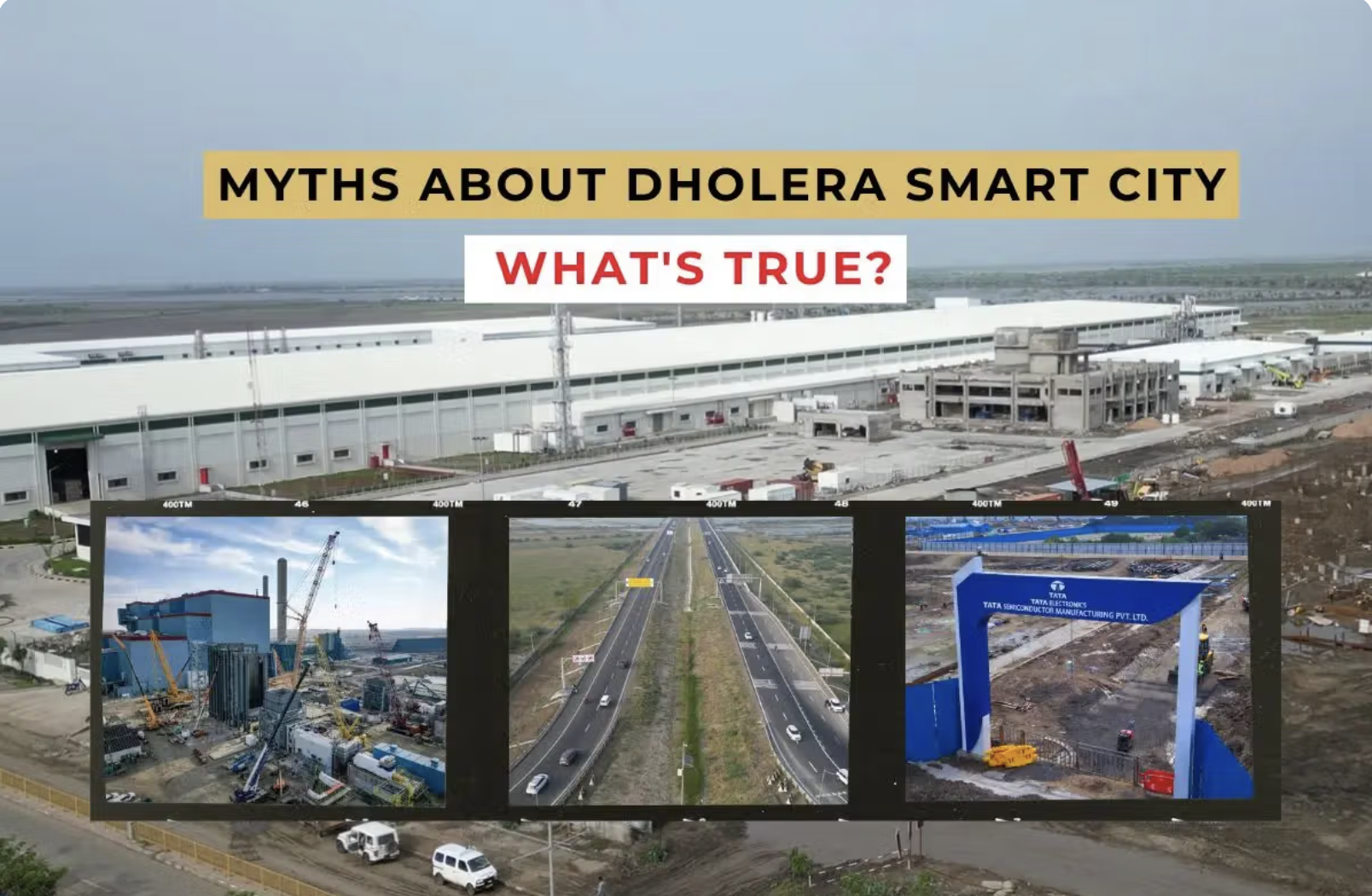
- The 109-km Ahmedabad–Dholera Expressway is built
and operational
- The Dholera International Airport completed Phase 1
construction and is in trial operations
- The ABCD Building — Dholera's administrative
headquarters — is functional
- Phase 1 infrastructure in the Activation Zone
(roads, drainage, utilities) is complete
- Tata Group is spending ₹91,000 crore to establish
India's first significant semiconductor fabrication plant in Dholera
When one of India's most credible industrial groups commits ₹91,000 crore to a location, that is not a signal that the project might stall. That is a binding capital commitment that locks in the project's future.
The honest answer: The risk of total project abandonment is very low in 2026. The risk of slower- than-expected timelines on outer zones remains real.
Concern #2: "What if the government changes and
support disappears?"
This concern assumes Dholera is a state government pet project that a new political party might cancel. That misunderstands the project's structure.
Dholera is not a Gujarat state project that the central government has endorsed. It is a central government programme — part of the Delhi–Mumbai Industrial Corridor — that the Gujarat state government is co-executing. DICDL, the developer, is a joint venture between the Government of India (through DMICDC) and the Government of Gujarat.
Cancelling Dholera would require both the central and state governments to simultaneously abandon India's flagship industrial corridor programme, write off billions in already-spent infrastructure investment, and walk away from Tata Electronics' ₹91,000 crore commitment.
That is not a realistic political scenario. The project is too large, too multi-party, and too far along for any government to walk away from without catastrophic economic and political consequences.
The honest answer: Political risk exists for any long-term project. For Dholera specifically, the multi-government, multi-institutional structure makes it significantly more durable than a single- party project.
Concern #3: "What about fraud — fake plots
and misleading sellers?"
This is the most legitimate and practical concern — because it is genuinely real.
Dholera's prominence has attracted opportunistic sellers alongside legitimate ones. Plots marketed as "Dholera plots" that are:
- Outside the official SIR boundary
- On agricultural land without NA conversion
- Without NOC clearance
- With disputed or unclear title
...are being actively sold by unverified sellers across India. This is where investors actually lose money in Dholera — not because the project fails, but because they bought the wrong thing from the wrong person.
Be cautious of inflated or fraudulent listings — speculative risks from unverified sellers are the primary practical danger for Dholera investors.
How to protect yourself completely:
| Risk | Protection | |---|---| | Fake or illegal plot | Verify NA Certificate independently | | Missing NOC | Confirm NOC clearance directly with the developer | | Disputed title | Get 7/12 extract and Encumbrance Certificate | | Outside SIR boundary | Cross-check against DICDL master plan | | Cash payment fraud | Always pay to registered company account, get receipts |
Work exclusively with NA/NOC-certified developers and verified brokers who have a documented history of plot delivery and registration. Every legitimate Dholera plot has a paper trail. If the seller cannot produce it, walk away.
The honest answer: Fraud risk is real but entirely avoidable with basic document verification. The process is not complicated — it just requires discipline.
Concern #4: "Will I actually make money,
or will prices stay flat?"
No one can guarantee returns. Anyone who does is either lying or selling you something. But here is what the data shows:
According to property listing platform 99acres, land rates in Dholera have risen 14.3% in the last year, 45.5% in the last 3 years, and 77.8% in the last 5 years.
That appreciation has happened during the infrastructure construction phase — before the airport is fully operational, before the semiconductor fab produces its first chip, and before the industrial workforce creates meaningful residential demand.
The investment case rests on a simple sequence: infrastructure completes → industries move in → workers need housing → residential demand rises → land prices follow. That sequence is well underway but not yet complete. Which is why prices are still significantly below what a fully operational industrial city would command.
Dholera was not planned as a residential project that later tried to attract jobs — it was planned the other way around. Large planned regions move at the pace of policy, infrastructure funding, and industrial uptake. Understanding this sequence is what separates investors who are frustrated by short-term flatness from those who are positioned for medium-term appreciation.
The honest answer: Past appreciation is real and documented. Future returns depend on your zone, entry price, and holding period. Minimum recommended horizon: 5 years. Ideal: 7–10 years.
Concern #5: "What if timelines keep slipping?"
They have slipped before. The Dholera airport was originally targeted for earlier completion. The metro rail is behind its original schedule. This is true and worth acknowledging.
But timeline slippage in a government infrastructure project is different from project failure. Roads that are 2 years late still get built. Airports that open 18 months behind schedule still open. The question is not "will it happen?" but "when?"
For investors, the practical implication is: do not buy Dholera land if you need liquidity in 2–3 years. Dholera is best suited for long-term investors aiming for capital appreciation rather than short-term profits — ideal for a 5 to 15 year holding period.
If your investment horizon is 5+ years, timeline slippage of 1–2 years on individual projects does not materially change your outcome. If your horizon is shorter, Dholera is not the right investment for you — and a trustworthy advisor will tell you that upfront.
The honest answer: Timelines will likely continue to be approximate rather than precise. This is a known feature of large government infrastructure projects — not a unique Dholera problem.
Concern #6: "Is the land legally mine
once I register?"
Yes — with one important condition: the registration process must be completed correctly.
The entire Dholera region operates under a special legal framework authorized by the Government of Gujarat. All land records are digitised and town planning schemes are strictly enforced. When you buy a plot inside the activated area, you are purchasing a title that is clear, marketable, and approved.
Registration through Gujarat's GARVI portal creates an official government record of your ownership. The mutation step (Naam Transfer) updates the 7/12 land record in your name. After both steps, your ownership is registered in the government's digital land records.
This category of plotted land is not required to be RERA-registered, so RERA is not the legal layer that protects you here — a registered sale deed, NA/NOC documentation, and correct mutation are. That's exactly why the document checks above aren't optional extras; they're the actual protection.
The honest answer: Legal ownership after correct registration is secure. The risk is in skipping steps — particularly mutation — which leaves records in the previous owner's name.
Who Should — and Should Not — Invest in Dholera
Being honest means being clear about who this investment suits and who it doesn't.
Dholera IS right for you if:
- You have a 5–10 year investment horizon
- You want government-backed, long-horizon land
appreciation rather than rental income
- You can commit ₹8 lakh and above without
needing that capital back soon
- You are willing to do basic document verification
or work with a verified broker who does it for you
Dholera is NOT right for you if:
- You need returns or liquidity within 2–3 years
- You are expecting rental income — Dholera does
not have an active rental market yet
- You cannot commit to a long hold without financial
stress
- You are buying based on a WhatsApp forward or an
unverified seller's brochure without doing document verification
The One Thing That Makes Dholera Safe or Unsafe
Everything above points to a single conclusion: Dholera's safety as an investment is not determined by the project — it is determined by what you buy and who you buy it from.
The project is government-backed, legally structured, and physically under construction. That part is not in question in 2026.
What is in question is whether the specific plot you are considering has a clean NA certificate, confirmed NOC clearance, a clear title chain, and a seller with a verifiable track record.
Get those right, and Dholera is one of the most structurally sound land investments available in India today for a patient, long-horizon buyer.
Get those wrong, and no amount of government backing protects you.
Frequently Asked Questions
Is Dholera RERA-registered? Dholera SIR as a region isn't a "RERA-registered" entity — RERA registration applies to individual real estate projects, not cities. For plotted-land schemes like the ones sold here, RERA registration is not required at all. What every genuine project should be able to show you instead is NA certification and NOC clearance — verify those directly with the developer.
Can NRIs invest in Dholera safely? Yes. NRIs can invest in Dholera subject to Indian property laws and proper documentation. The registration process can be completed using a Power of Attorney for the Sub-Registrar step. All other steps can be done remotely.
What is the biggest risk for a first-time Dholera buyer? The biggest risk is purchasing non-approved or agricultural land without proper legal verification. This is entirely avoidable with basic document checks — NA certificate, NOC clearance, and 7/12 extract.
Is there a risk of Dholera becoming a ghost city? The ghost city risk applies to cities with no industrial anchor and no employment base. Dholera has a ₹91,000 crore semiconductor fab, government-backed industrial zones, and DMIC alignment. The employment base is being built before the residential population — which is the correct sequence for a planned industrial city.
How do I verify a seller is legitimate? Ask for the project's NA certificate and NOC clearance, verify the developer's past plot deliveries, and confirm all five key documents are available. A legitimate seller has no reason to resist any of these checks.
Summary
Dholera is safe to invest in — with the right plot, the right documents, and the right time horizon.
It is not safe to invest in blindly, based on a brochure, with a seller who cannot produce verified documents, or with an expectation of short-term returns.
That distinction is what separates investors who do well in Dholera from those who don't. And it is exactly the distinction that DealWithIt is built around.
We only show buyers plots that are NA/NOC- certified, title-clear, and inside the official SIR boundary. Every time.
Talk to a DealWithIt advisor — no pressure, just clarity. Let us walk you through verified options and answer every concern you have before you commit to anything.