The DMIC is India's largest infrastructure project — 1,500 km, 25 industrial nodes, and a $100 billion investment plan. Dholera is its most advanced node. Here's why that matters for investors in 2026.
DMIC Explained: Why Dholera Is at the Centre of India's Industrial Growth
KEY TAKEAWAYS
- The Delhi-Mumbai Industrial Corridor (DMIC) is a 1,500-km industrial spine connecting Delhi to Mumbai, with a planned investment of over $100 billion across 25 industrial nodes.
- The Western Dedicated Freight Corridor (WDFC) — the logistical backbone of DMIC — was fully completed in March 2026, making the entire 1,506-km rail freight route from JNPT to Dadri operational.
- Of all 25 DMIC nodes, Dholera SIR is the most advanced — the only one with an operational expressway, a near-ready international airport, a semiconductor fab under construction, and funded trunk infrastructure.
- Approximately one-third of the $100 billion total DMIC investment is expected to flow into Gujarat, and Dholera leads that allocation.
- DMIC influences a zone covering 14% of India's population and 17% of its total area — 173 million people across 82 districts in six states.
- Residential land inquiries in Dholera tripled in the first half of 2026 as industrial activity accelerated.
Introduction
Most first-time investors who look at Dholera focus on the city itself — the airport, the expressway, the semiconductor fab. What fewer people understand is the larger architecture that Dholera sits inside.
Dholera is not just a smart city being built in Gujarat. It is the flagship node of India's single largest infrastructure project: the Delhi-Mumbai Industrial Corridor.
That distinction matters enormously. It means Dholera is not funded, designed, or managed in isolation. It is part of a nationally coordinated industrial strategy that connects Delhi to Mumbai through 1,500 kilometres of roads, rail, ports, power networks, and planned cities — a project designed to transform how India manufactures, exports, and grows.
Understanding DMIC is understanding why Dholera is not optional for serious industrial players, and why land inside Dholera SIR sits in a fundamentally different investment category from ordinary real estate.
This post explains what DMIC is, how it works, why it was built, and why — out of 25 nodes across six states — Dholera has emerged as the most advanced and most strategically important one.
What Is the Delhi-Mumbai Industrial Corridor?
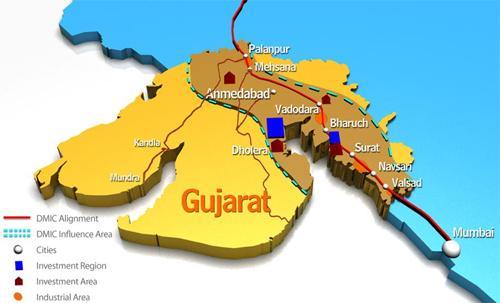
The Delhi-Mumbai Industrial Corridor (DMIC) is a $100 billion infrastructure programme developed jointly by the Government of India and the Government of Japan. It runs along a 1,500-kilometre route connecting the National Capital Region (Delhi) to the commercial capital (Mumbai), passing through six states: Uttar Pradesh, Haryana, Rajasthan, Gujarat, Madhya Pradesh, and Maharashtra.
The corridor is built around a single spine: the Western Dedicated Freight Corridor (WDFC), a 1,506-km dedicated railway line for freight movement — no passenger trains, no congestion, trains capable of running at up to 100 km/h versus the 20–25 km/h average on shared tracks.
On both sides of this railway spine, a 150-kilometre influence zone has been designated as DMIC territory. Within that zone, 25 industrial nodes are being developed — planned cities, industrial parks, logistics hubs, and investment regions — each designed to host manufacturing, warehousing, and ancillary industries at scale.
The DMIC is not a single project. It is a framework — a coordinated national commitment to build India's manufacturing backbone along one of the world's most commercially significant routes.
The Scale: Why This Is Unlike Anything Else in India
To understand what Dholera's DMIC positioning actually means, you first need to understand the scale of the project it sits within.
Geography and Population
The DMIC influence zone covers 17% of India's total land area and is home to 173 million people — roughly equivalent to the entire population of Russia. It spans 82 districts across six of India's most economically active states. Every factory, logistics park, or industrial cluster built within this zone feeds into a system designed for integrated, end-to-end connectivity.
Financial Scale
The total planned investment across DMIC is estimated at over $100 billion. According to DMIC project documents and industry analysis, this investment is expected to generate more than 3 million direct and indirect jobs across the corridor. Even a fraction of that activity creates a massive downstream demand for land, housing, and services in every major node.
The Freight Backbone: Now Fully Operational
The most important infrastructure event of 2026 for DMIC investors was not widely reported outside of logistics and industry publications. On March 31, 2026, the Western Dedicated Freight Corridor was declared fully complete — end to end, 1,506 km, from JNPT (Jawaharlal Nehru Port Terminal) in Navi Mumbai all the way to Dadri in Uttar Pradesh.
This is significant because the WDFC is what makes DMIC work. Without it, the industrial nodes along the corridor are well-located but disconnected. With it, a factory in Dholera can move goods to India's busiest port at consistent freight train speeds, on a dedicated track, with no competition from passenger rail. The corridor that DMIC's entire economic logic depends on is now live.
The 25 Nodes: Why Most Are Still Catching Up
DMIC envisions 25 industrial nodes distributed across the six-state corridor. In theory, every node should develop roughly in parallel. In practice, they have not — and the reasons for Dholera's leadership within that framework are worth understanding.
Phase 1 of DMIC identified seven priority investment nodes:
| Node | State | Status (2026) | |---|---|---| | Ahmedabad-Dholera Investment Region | Gujarat | Most advanced — airport, expressway, semiconductor fab | | Pitampura-Dhar-Mhow Investment Region | Madhya Pradesh | Early-stage planning | | Dadri-Noida-Ghaziabad Investment Region | Uttar Pradesh | Partial industrial development | | Manesar-Bawal Investment Region | Haryana | Industrial activity, limited smart city progress | | Kushkhera-Bhiwadi-Neemrana Investment Region | Rajasthan | Moderate industrial activity | | Igatpuri-Nashik-Sinnar Investment Region | Maharashtra | Developing, some industrial tenants | | Dighi Port Industrial Area | Maharashtra | Port-linked, logistics-focused |
Dholera leads this list by a significant margin. The reasons are structural, not accidental.
Gujarat's land acquisition framework, the state government's consistent financial commitment (demonstrated most recently by the ₹610 crore budget allocation in 2026), DICDL's focused management of the SIR, and the early decision to build the Ahmedabad-Dholera Expressway have all combined to put Dholera roughly a full development cycle ahead of every other Phase 1 node.
When industrial players evaluate DMIC locations, Dholera is the only node that can currently offer all of the following in combination: an operational expressway, a near-ready international airport, confirmed trunk infrastructure funding, plug-and-play utilities across the Activation Area, and an active ₹91,000 crore semiconductor fab under construction.
No other DMIC node can say all of those things today.
Gujarat's Role in DMIC: Disproportionately Large
Of the six states in the DMIC corridor, Gujarat plays a disproportionately important role.
Approximately 38% of the Western Dedicated Freight Corridor's total length passes through Gujarat — the highest of any single state. Nearly one-third of the entire $100 billion DMIC investment is expected to flow into Gujarat across all phases of development.
Within Gujarat, six mega industrial nodes have been identified under DMIC. Dholera SIR and Dholera Metro City are among the first to receive active development. The Gujarat government has structured this development through DICDL — Dholera Industrial City Development Limited — a joint venture between the Government of India and the Government of Gujarat, giving the project dual sovereign backing and consistent funding access.
This institutional structure matters for investors. Dholera is not a private developer's project that can be wound down or redirected. It is a jointly owned government entity with central and state accountability. Infrastructure spending in Dholera is budget-line spending, which is why announcements like the 2026 Gujarat Budget allocation carry the weight they do.
The Multimodal Advantage: What "Connectivity" Actually Means Here
One phrase gets overused in real estate marketing: "well-connected." Most properties described as well-connected have access to a decent road. Dholera's connectivity is of a different order entirely.
By Road
The 109-kilometre Ahmedabad-Dholera Expressway is operational. It cuts travel time between Ahmedabad and Dholera to under one hour. The expressway connects directly to the broader National Highway network, linking Dholera to Mumbai, Delhi, and the rest of the country's road grid.
By Rail (Freight)
The Western Dedicated Freight Corridor, now fully operational as of March 2026, passes through Gujarat. The DFC alignment connects Dholera's industrial zone to JNPT (Mumbai) for export and to Dadri (Delhi) for domestic distribution. For manufacturers, this means predictable, high-capacity freight movement — the single biggest operational cost for large factories after labour and power.
A new Dankuni-Surat Dedicated Freight Corridor was also announced in the Union Budget 2026-27 and is in fast-track pre-construction planning. This 2,100-kilometre east-west corridor, passing through Gujarat, will further enhance Dholera's freight connectivity when operational.
By Air
The Dholera International Airport — Phase 1 civil works completed December 2025, calibration flights conducted January-February 2026 — will provide direct air connectivity for industrial executives, export logistics, and the skilled workforce that semiconductor and advanced manufacturing operations require. Airports are not just passenger facilities; they are supply chain nodes for high-value, time-sensitive components.
By Sea
Dholera is located approximately 80 kilometres from the Gulf of Khambhat. Plans for a Dholera customs port and sea connectivity are part of the long-term master plan, positioning the city as a future multimodal hub with direct access to maritime export routes.
No other DMIC node currently has all four modes — road, rail, air, and sea access — simultaneously under development. Dholera is the only location in India's industrial corridor framework where a manufacturer can, in the near term, receive components by air, distribute finished goods by rail, export by sea, and connect the executive team to Mumbai or Delhi by expressway in under an hour.
What DMIC Positioning Does for Land Values: The Historical Pattern
For investors trying to understand the financial implications of Dholera's DMIC position, historical precedent from comparable corridor projects is instructive.
Industrial corridors of this type — combining dedicated freight rail, planned industrial nodes, and multimodal connectivity — have a documented pattern of land value behaviour in every economy that has built them.
The appreciation cycle typically follows three phases:
Phase 1 — Announcement and Early Planning (Years 0–5): Land prices begin rising modestly from a low base as early-mover investors and informed buyers enter. Most buyers remain skeptical. This is the highest-risk, highest-potential-reward entry window.
Phase 2 — Infrastructure Confirmation and Construction (Years 5–12): Major catalysts confirm the project is real — expressway opens, freight corridor goes live, anchor industrial tenant confirmed. Land prices accelerate. This is where informed retail investors begin entering in volume.
Phase 3 — Industrial Operations Begin (Years 12+): Workers arrive, housing demand spikes, commercial activity follows. Prices reflect operational value rather than just potential. Entry prices for new buyers are significantly higher than Phase 2.
Dholera is currently deep in Phase 2 and approaching the Phase 3 transition. The expressway is operational. The freight corridor is live. The semiconductor fab is 50% built. First chip production is targeted for December 2026. The Phase 3 trigger — industrial operations at scale — is within 12–18 months.
According to property market data, land prices in Dholera rose by approximately 77.8% over the last five years and 45.5% over the last three years. That appreciation is Phase 2 price movement. Phase 3 appreciation, driven by actual industrial demand for worker housing and commercial space, has historically been significantly larger in comparable corridors globally.
The Semiconductor Anchor: Why Dholera Is Irreplaceable in DMIC
Every industrial corridor needs anchor tenants — major employers whose presence validates the location for smaller industries and triggers downstream residential and commercial demand. In Korea's industrial corridor development, it was steel. In Taiwan's Hsinchu Science Park, it was semiconductor manufacturing.
In Dholera, the anchor is the Tata Electronics semiconductor fab — a ₹91,000 crore ($11 billion) fabrication facility being built in partnership with Taiwan's Powerchip Semiconductor Manufacturing Corporation (PSMC).
The numbers are concrete:
- Investment: ₹91,000 crore — one of India's three largest single industrial investments in history
- Capacity: 50,000 wafers per month, producing approximately 3 billion chips annually
- Employment: 20,000+ direct and indirect jobs in the Dholera region
- Timeline: Construction 50% complete as of April 2026; first chips targeted December 2026
- Global partnership: Tata-ASML MoU signed May 2026 at PM Modi's Netherlands state visit — ASML supplies the only lithography machines capable of producing modern chips
What makes a semiconductor fab different from other anchor industries is the employment multiplier and the infrastructure pull. Semiconductor workers are highly paid engineers and technicians — they spend significantly more on housing, services, and education than equivalent headcount in other industries. Over 1,500 serviced apartments for workers are already under construction at Dholera, with 500 nearly complete.
This is not speculative housing being built on the hope that workers will come. Workers are being recruited. Infrastructure to house them is being built simultaneously. The economic ecosystem that follows large-scale semiconductor manufacturing is well-documented — and it is beginning to form in Dholera now.
What DMIC Means for First-Time Plot Buyers: The Practical Implications
Understanding DMIC's scale and Dholera's position within it is useful context. But first-time buyers need to translate that context into practical investment logic.
Here is what Dholera's DMIC positioning means in concrete terms for someone evaluating a plot purchase:
Demand Is Structural, Not Speculative
In most real estate markets, appreciation depends on sentiment — on buyers continuing to believe prices will rise. In Dholera, appreciation is increasingly driven by structural demand: an industrial workforce that needs housing, a growing commercial ecosystem that needs office and retail space, and a city-scale infrastructure build that will not be abandoned because the government balance sheet is behind it.
Structural demand is more predictable and more durable than sentiment-driven demand. When the Tata fab produces its first chip in December 2026, the demand signal will be concrete and irreversible.
The Entry Window Is Finite
Phase 2 appreciation in industrial corridor markets ends when Phase 3 begins — when prices already reflect operational value rather than potential. At Dholera, the gap between current prices and post-operational prices is measurable in months, not years.
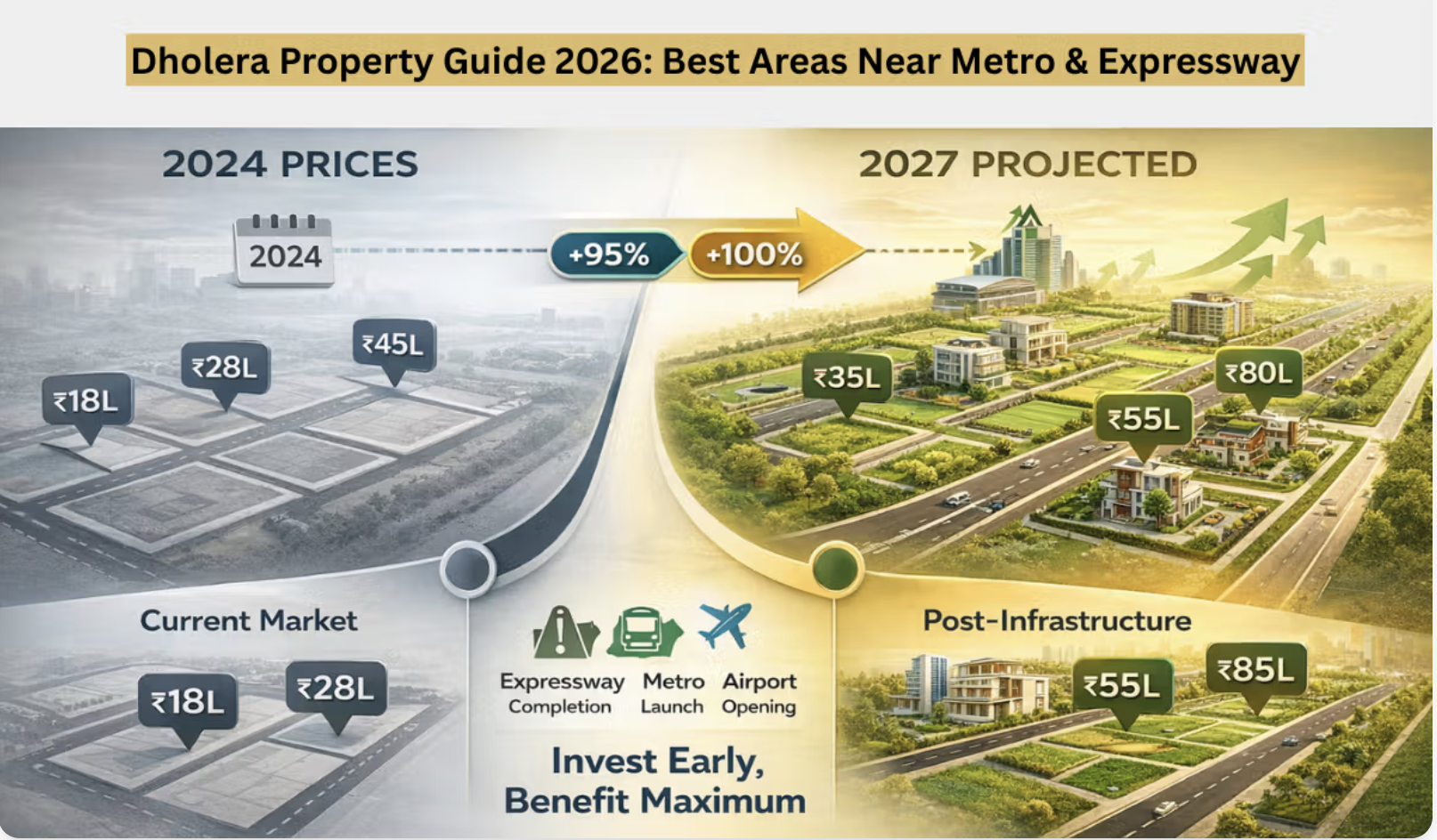
Plots in TP1 and TP2 zones currently range from ₹11,000 to ₹15,000+ per sq. yd. Entry-level 100 sq. yd. residential plots start from approximately ₹8.5 lakh in developing zones. These prices exist because Dholera is still in its infrastructure delivery phase. Once the semiconductor fab goes live, once the airport begins passenger operations, and once the workforce arrives in volume, prices will reflect a fully operational industrial city — not one that is still being built.
Legal Verification Remains Non-Negotiable
DMIC positioning does not change the fundamentals of safe land investment. Every plot inside Dholera SIR must be verified for:
- NA certification: Valid Non-Agricultural order confirming legal land use conversion
- Title clarity: Clean title with no encumbrances or disputes
- NOC status: Confirmed NOC clearance (this category of plotted land is not required to be RERA-registered)
- TP scheme sanction: Confirmation the plot falls within an approved Town Planning zone inside the SIR boundary
Plots outside the SIR boundary are priced lower for a reason — they sit outside the planning framework and may never receive the infrastructure that DMIC and the Gujarat government are funding. The price difference between a verified inside-SIR plot and an unverified peripheral plot can be ₹3,000–₹6,000 per sq. yd. That saving is not real — it is a risk premium you are absorbing without knowing it.
Dholera vs Other DMIC Nodes: A Straight Comparison
For investors considering whether to look at other DMIC nodes alongside Dholera, a direct comparison is more useful than generalities.
| Factor | Dholera SIR | Other Phase 1 DMIC Nodes | |---|---|---| | Expressway connectivity | Operational (109 km, under 1 hour to Ahmedabad) | Most in planning or partial construction | | International airport | Phase 1 complete, calibration flights done (2026) | None operational or near-ready | | Anchor industrial tenant | Tata Electronics ₹91,000 crore semiconductor fab, 50% built | No equivalent confirmed anchor at this scale | | Trunk infrastructure funding | ₹610 crore confirmed in Gujarat Budget 2026-27 | Varies; most at earlier funding stages | | Land price entry point | ₹8,500–₹15,000+/sq. yd. depending on zone | Varies widely; comparably advanced nodes often higher | | Government structure | DICDL joint venture — central + state government | Varies by state; some less structured | | Freight corridor access | WDFC operational (March 2026) | Same corridor, but Dholera has expressway supplement | | Worker housing under construction | 1,500+ units, 500 near complete | Minimal at equivalent nodes |
Dholera does not just lead on one or two factors. It leads on every metric that determines when an industrial node transitions from planning to operations. That combination — not any single element — is what makes it the most investable node in the entire DMIC framework today.
Frequently Asked Questions
What is DMIC in simple terms? The Delhi-Mumbai Industrial Corridor is India's largest infrastructure project — a planned industrial and urban development zone running 1,500 km from Delhi to Mumbai. It is built around a dedicated freight railway and includes 25 industrial cities, logistics hubs, and planned residential zones designed to make India a global manufacturing hub.
What is Dholera's role in DMIC? Dholera SIR is the Ahmedabad-Dholera Investment Region — one of the seven first-phase priority nodes in DMIC and the most developed of all 25 nodes. It is the only DMIC node currently combining an operational expressway, near-ready international airport, active semiconductor fab construction, and fully funded Phase 1 trunk infrastructure.
Is the Western Dedicated Freight Corridor open? Yes. The 1,506-km Western Dedicated Freight Corridor was fully completed on March 31, 2026, connecting JNPT (Mumbai) to Dadri (Delhi). It runs through Gujarat and forms the logistical backbone of the entire DMIC project. Freight trains on the WDFC can run at up to 100 km/h — roughly four to five times faster than trains on mixed passenger-freight tracks.
How does DMIC positioning affect Dholera plot prices? DMIC positioning means Dholera's industrial demand is structural — driven by a government-backed freight corridor, confirmed industrial tenants, and an active semiconductor fab — rather than speculative. This makes long-term appreciation more predictable than in unplanned markets. Land prices have risen approximately 77.8% over five years and the appreciation trend is accelerating as operational milestones approach.
Which is the best zone to buy in Dholera for long-term investment? TP1 and TP2 zones — especially areas close to the expressway interchange, the Central Business District (ABCD Building), and the airport corridor — are considered the best-positioned zones for long-term appreciation. The Activation Area (TP2 West) has the most developed infrastructure but commands premium prices. For first-time buyers, TP1 and TP2 offer a better balance between price and appreciation upside over a 5–10 year horizon.
What other DMIC nodes should I compare with Dholera? The closest comparison nodes are in Maharashtra (Aurangabad Industrial City / AURIC) and Rajasthan (Neemrana). AURIC has attracted some industrial investment but does not have Dholera's airport, semiconductor anchor, or state-level infrastructure funding equivalent. Neemrana is proximity-driven (near Delhi NCR) rather than greenfield-planned. Neither offers the combination of connectivity, industrial anchor, and funded infrastructure that Dholera does in 2026.
Is investing in a DMIC node different from regular real estate investment? Yes, in important ways. DMIC node investments are driven by industrial demand cycles rather than residential sentiment cycles. This means appreciation is tied to measurable milestones — freight corridor completion, anchor tenant operations, airport opening — rather than to broader market sentiment. The downside is that the timeline is longer; the upside is that the demand drivers are more structural and less reversible.
The Bigger Picture: India's Industrial Ambition and Where Dholera Fits
India's stated goal is to become a $5 trillion economy and a global manufacturing hub within this decade. The DMIC is the single most significant piece of physical infrastructure that connects those ambitions to economic reality.
Every major economy that made the transition from developing to industrial — South Korea, Taiwan, Singapore, China — did it through corridor-based industrial development. They built the infrastructure first, created the connectivity, landed the anchor industries, and then let residential and commercial demand follow.
India is doing the same thing. DMIC is the corridor. The Western Dedicated Freight Corridor — completed March 2026 — is the spine. The semiconductor mission, now backed by both state and central government money and anchored by Tata Electronics' ₹91,000 crore commitment, is the anchor industry play.
And Dholera is where the most concentrated version of all of this is happening simultaneously.
For a first-time buyer trying to understand why Dholera keeps being described as India's most important investment city, this is the answer. It is not one good thing happening in isolation. It is the convergence of freight connectivity, air connectivity, road connectivity, sovereign funding, industrial anchor tenants, and planned urban infrastructure — all at the same location, at the same time, in 2026.
That kind of convergence does not repeat itself often. In India's post-independence history, it may not have happened in exactly this form before.
Explore available Dholera plots with DealWithIt — India's trusted Dholera specialist. Verified titles, NA/NOC-certified inventory, and honest guidance for first-time buyers. Book a free consultation or arrange a site visit today.
Last updated: June 2026
Author: DealWithIt Research Desk — specialists in Dholera SIR plot investment.