How Dholera land prices have moved from ₹300/sq yd to ₹15,000+ over a decade — and what the next five catalysts mean for appreciation. A data-first look for serious investors
Dholera Property Appreciation: A Decade of Data and What Comes Next
Most investment conversations about Dholera start with what might happen. This one starts with what already has.
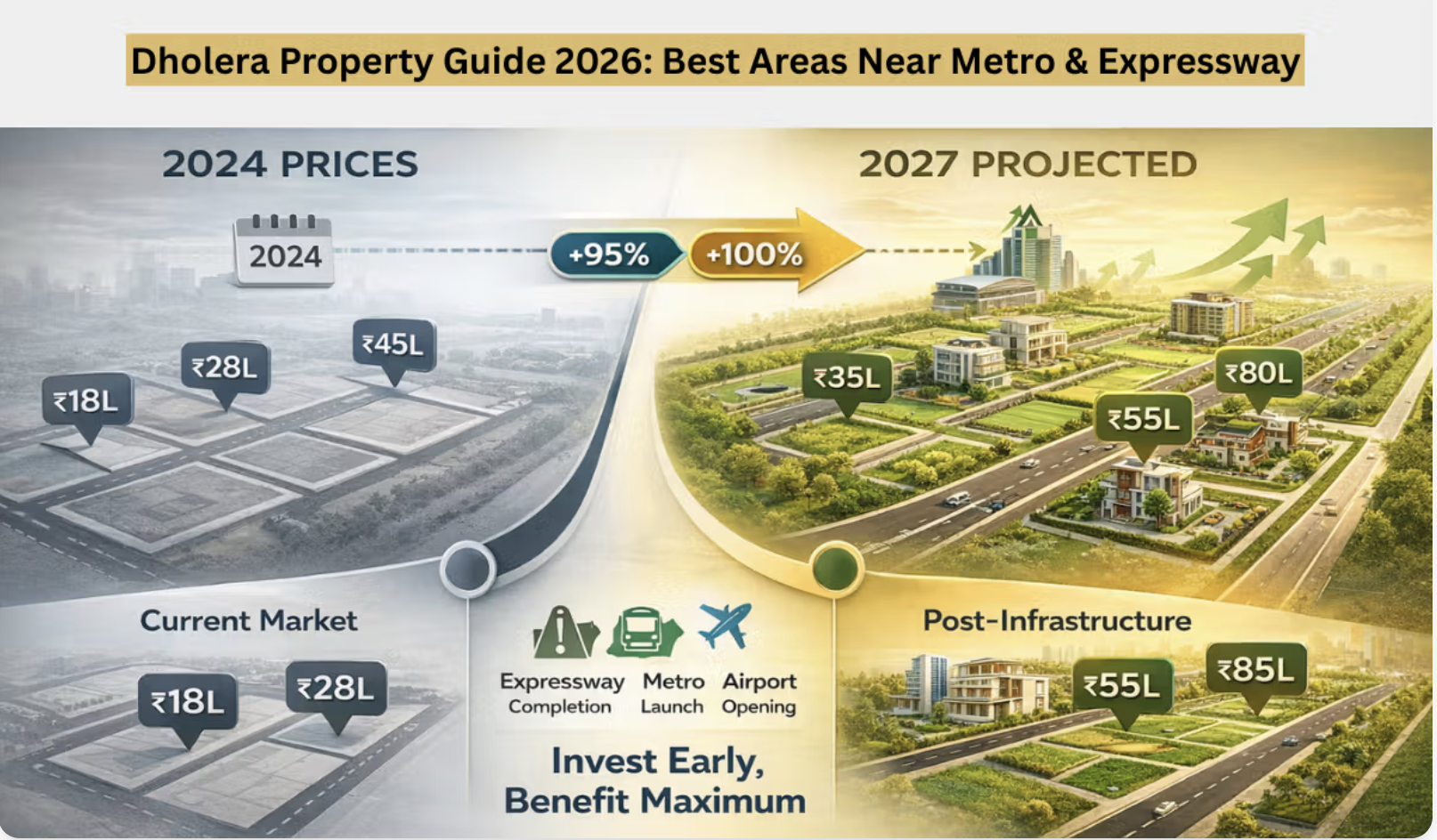
Between 2015 and 2026, land prices in Dholera's prime zones moved from approximately ₹300 per sq yd to ₹15,000 per sq yd and above in the Activation Area. That's a 50x move over a decade — not in one burst, but in a series of distinct steps tied directly to infrastructure events.
Understanding how that appreciation happened tells you more about Dholera's investment case than any projection. If you can map what triggered each price move in the past, you can evaluate whether the conditions for the next one are in place.
This post does exactly that.
Why Dholera Appreciation Works Differently from Normal Real Estate
In most Indian real estate markets, prices move on sentiment — an announcement, a new project launch, media coverage. Prices often peak before the infrastructure arrives and sometimes correct when delivery is delayed.
Dholera works differently. Historically, its strongest appreciation has come after infrastructure becomes operational and usable — not when it was announced.
This matters because it makes Dholera price movement more predictable than speculative corridors. You're not betting on whether the government will follow through. You're evaluating whether the execution has happened yet and whether the market has fully priced it in.
The data from the last decade supports this pattern clearly.
Phase 1 (2015–2018): Planning Certainty Creates the First Move
Before 2017, Dholera land in most zones traded between ₹300 and ₹1,500 per sq yd. The project existed on paper — master plan approved, DMIC framework announced, land pooling initiated — but almost nothing was visible on the ground.
Then two things happened. The Town Planning Scheme for the Activation Area was formally approved. Land pooling was completed in the core zones. These weren't construction milestones, but they were certainty milestones: investors now knew exactly which land was inside the planned development boundary and which wasn't.
By 2018, plots in the Activation Area and TP1 zones were already trading at ₹2,500–₹3,000 per sq yd. Planning clarity alone — before a single road was laid — drove the first significant appreciation wave.
The lesson: The gap between announcement and planning certainty is where early investors enter. By the time ground is broken, that window has usually closed.
Phase 2 (2019–2021): Visible Construction, Visible Prices
Between 2019 and 2021, the Activation Area started looking different. Roads were being graded. Underground utility corridors were being installed. The ABCD Building — Dholera's administrative and civic centre — began to take shape. For the first time, an investor visiting the site could see a city being built, not just promised.
This visibility drove the second wave. Prices in the Activation Area moved to ₹4,000–₹6,000 per sq yd by 2021. Plots in outer zones like TP1 and the expressway corridor, which had seen more modest gains, began attracting serious attention as the Activation Area's price floor rose.
The pandemic slowed momentum briefly in 2020, but did not reverse it. Government-backed infrastructure projects with sanctioned budgets don't stop for market cycles the way private township projects do — and buyers learned this about Dholera during this period.
Phase 3 (2022–2024): Industrial Anchors Change the Game
The third and largest appreciation phase was triggered not by infrastructure completion, but by industrial commitment.
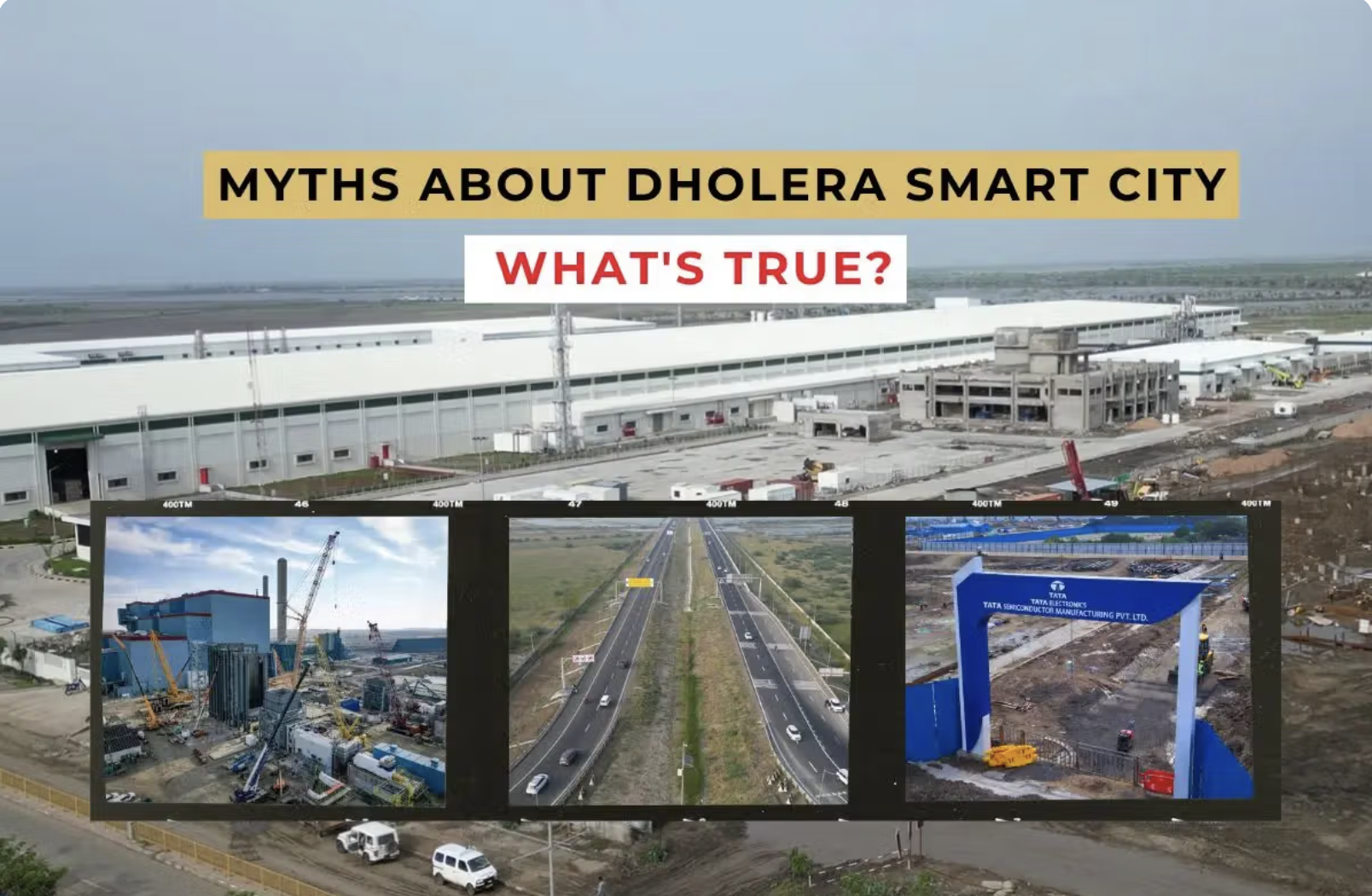
In early 2024, the central government approved the Tata Electronics–PSMC semiconductor fab at Dholera — a ₹91,000 crore facility planned as India's first commercial 300mm wafer fabrication plant. This was not a small investment announcement. It was a national strategic commitment, with cabinet approval, fiscal support from the India Semiconductor Mission, and a formal SEZ notification.
The market responded immediately. Verified plots in the Activation Area that had been trading at ₹6,000–₹8,000 per sq yd in late 2023 moved to ₹10,500–₹15,000 per sq yd by 2024. In TP1 zones, prices roughly doubled between 2022 and 2024.
One data point illustrates this clearly: an NRI investor who purchased a 500 sq yd plot in the Activation Area at ₹6,000 per sq yd in 2021 saw the same plot valued at ₹10,500 per sq yd by 2025 — a 75% gain in four years, without the land being developed or generating any income.
Outside SIR plots — those without formal town planning approval — did not appreciate at the same rate. The industrial commitment reinforced the premium for legally verified, inside-SIR land. The gap between compliant and non-compliant plots widened, not narrowed.
The Next Five Catalysts: What Could Drive the Next Price Step
History shows that Dholera price moves are event-driven, not time-driven. The question for any investor evaluating Dholera today is: which events are still ahead, and have prices already accounted for them?
Here is an honest assessment of the five upcoming catalysts — what each is, what the current status is, and what it might mean for appreciation.
- Dholera International Airport — Commercial Operations
What it is: A greenfield international airport at Navagam, 20 km from the Activation Area, built on 1,426 hectares. Phase 1 includes a 3,200-metre Code 4E runway capable of handling wide-body aircraft, a terminal sized for 3.5 million passengers per year, and cargo facilities.
Current status: Phase 1 construction was completed in December 2025. The airport is in licensing, calibration, and operational trial stages. Security appointments have been made — a step typically taken when a facility is preparing for real operations, not just trials. Cargo operations were expected before mid-2026.
Appreciation impact: Airports are among the most reliable price triggers in Indian land markets. The pattern is consistent: prices accelerate in the 12–18 months before full commercial operations begin, and reset higher once the airport is live. The Dholera airport is in that pre-operation window right now. It is not fully open yet — meaning the market has not fully priced in operational reality.
- Tata Electronics Semiconductor Fab — First Chip Production
What it is: India's first commercial 300mm wafer fab, with a planned capacity of 50,000 wafers per month. Total investment: ₹91,000 crore (~USD 11 billion). Technology partner: PSMC (Taiwan). Equipment partner: ASML (Netherlands, MoU signed May 2026 in PM Modi's presence).
Current status: Construction is approximately 50% complete. First chip production is officially targeted for December 2026. The facility has onboarded specialized cleanroom engineering firm IAQ Group (Malaysia). INOX Air Products is building a dedicated ₹500 crore ultra-high-purity gas facility in Dholera specifically to serve the fab.
Appreciation impact: When a facility of this scale begins producing output, it creates an immediate and structural demand base — for housing, for commercial services, for logistics. The Tata fab is expected to create more than 10,000 direct jobs and 20,000 indirect jobs. Those people need somewhere to live. That demand has not yet arrived in the residential market. December 2026 is when it starts to.
- Ahmedabad–Dholera High-Speed Rail — Cabinet Approval
What it is: A high-speed rail connection between Ahmedabad and Dholera at 220 kmph, reducing travel time to approximately 34 minutes. Sanctioned cost: ₹20,667 crore.
Current status: Cabinet approved in May 2026. Project is moving to execution planning.
Appreciation impact: Every major city that received high-speed rail connectivity saw a permanent step-up in land values in the corridor served. Dholera going from a 45-minute expressway drive to a 34-minute high-speed rail commute from Ahmedabad changes its positioning entirely — from an investment destination to a plausible residential city for Ahmedabad professionals. That reclassification, when it happens, tends to compress the price gap between Dholera and Ahmedabad's outer suburbs significantly.
- National Maritime Heritage Complex (NMHC) at Lothal — Phase 1 Opening
What it is: The world's largest maritime museum, built across 400 acres at Lothal — the Indus Valley site approximately 30 km from Dholera — under the government's Sagarmala Programme with a total budget of ₹4,500 crore. Phase 1A includes six main museum galleries, an ancient Lothal township recreation, a jetty walkway, and open-air naval displays.
Current status: Phase 1A is targeted to open in July 2026. The government has signed MoUs with 10 countries to participate in the complex. Connecting highways are being upgraded to four lanes.
Appreciation impact: Tourism infrastructure changes the character of a region. Industrial cities without cultural or leisure destinations struggle to attract residents beyond the workforce they employ. The NMHC gives the Dholera-Lothal corridor a tourism identity — and hospitality investment follows tourism investment. A 5-star hotel has already been pre-leased in the area. Leisure infrastructure converts a city from a place people work to a place people choose to live. That transition, over time, drives residential land demand higher.
- SEZ Designation — April 2026
What it is: The Dholera SIR was formally designated a Special Economic Zone in April 2026. This enables export-oriented manufacturers to set up within the SIR and access SEZ tax benefits — including income tax holidays and duty exemptions.
Current status: Notified and active.
Appreciation impact: SEZ designation opens Dholera to a new category of industrial tenant that wasn't accessible before. Export-oriented manufacturers — particularly in electronics, defense, and precision components — can now set up with materially better economics. More industrial tenants mean more jobs, more housing demand, and more commercial activity. The appreciation impact is gradual but structural.
What This Means for a First-Time Investor
If you're evaluating Dholera for the first time in mid-2026, here is the honest picture:
The big appreciation has already happened. Anyone who bought in 2016–2018 has seen extraordinary returns. That phase is complete. You are not entering at ₹300 per sq yd.
The next appreciation phase is still ahead — but the timeline is longer. The five catalysts above are real and verified, not speculative. But several of them (high-speed rail, full fab operations, airport at scale) will play out over 3–7 years. The appreciation they drive will be real, but not immediate.
Zone selection matters more than timing. At current prices, the difference between buying a well-located, legally verified plot inside the SIR versus a cheap outside-SIR plot is enormous — both in risk profile and in appreciation potential. The data from the last decade shows this gap widening with every infrastructure milestone, not closing.
This is a 5–10 year investment, not a 2-year trade. Investors who entered Dholera in 2018 with a 7-year horizon have done exceptionally well. Investors who entered expecting to sell in 2020 often found the market illiquid and below their expectations. The investment works when you align your holding period with Dholera's development timeline.
The Documents That Protect Your Appreciation
Price appreciation only creates value if you can sell. And you can only sell if your documentation is clean. Before any price conversation becomes a commitment, verify:
NA (Non-Agricultural) Order — land legally converted for residential/commercial use TP Scheme inclusion — the plot falls under an approved Town Planning Scheme inside the SIR Clear title — no encumbrances, disputes, or multiple ownership claims NOC status — the plot is NOC-cleared (this category of plotted land is not required to be RERA-registered) Layout approval — if buying in a township, the layout is approved by the relevant authority
A plot that has appreciated 10x on paper but has a title dispute or missing NA order cannot be easily sold. Documentation isn't paperwork — it's what converts appreciation into actual returns.
Frequently Asked Questions
How much has land appreciated in Dholera over the last decade? In prime zones like the Activation Area and TP1, Dholera land has appreciated approximately 15–25x since 2015 — from ₹300–₹800 per sq yd to ₹11,000–₹22,000 per sq yd today. Outer zones and outside-SIR land have appreciated less, but the gap between prime and peripheral has widened over time.
What caused Dholera land to appreciate so much? Each appreciation wave was tied to a specific infrastructure event — planning approval, visible construction, the Tata semiconductor fab announcement, expressway opening, and airport completion. Dholera prices respond to execution, not just announcement. That makes each wave somewhat predictable, but also means appreciation doesn't happen uniformly across the city.
Is Dholera still a good investment in 2026 after prices have already risen? The 50x opportunity from 2015 is gone. But the next wave of appreciation — driven by airport operations, first chip production, high-speed rail, and the Lothal tourism complex — is still ahead. The entry price is higher, the holding period required is similar, and the upside is more moderate. For a first-time investor with a genuine 7–10 year horizon, verified inside-SIR plots at current prices remain a rational long-term position. For a 2-year trader, they are not.
Which zone has the best appreciation potential today? Airport vicinity plots (near Navagam) are currently at the lowest relative price point among prime SIR zones — and are closest to the next major catalyst (airport operations). TP1 offers the best balance of price and development trajectory for residential investors. The Activation Area has the strongest infrastructure but the highest current prices.
Does outside-SIR land also appreciate? Yes, but significantly less than inside-SIR land, and the gap has grown with each infrastructure milestone. Outside-SIR plots also carry higher documentation risk and lower resale liquidity. The lower entry price reflects these realities, not a hidden opportunity.
What is the minimum holding period recommended for Dholera investment? Based on the historical pattern of appreciation in Dholera, a minimum 5–7 year holding period is appropriate. The city's development is phased over multiple years, and the strongest gains have consistently come to investors who held through infrastructure completion rather than exiting before it.
Can NRIs invest in Dholera plots? Yes. NRIs can purchase NA-converted non-agricultural plots in India, including in Dholera SIR, subject to FEMA regulations. A Power of Attorney is typically used if the buyer is not present in India for the registration process. Documentation requirements are identical to those for resident buyers.
Key Takeaways
Dholera land in prime zones has appreciated 15–25x since 2015 — each wave tied to a specific infrastructure event, not sentiment. The next five catalysts — airport operations, first chip production, high-speed rail, Lothal NMHC, and SEZ designation — are all real, verified, and still ahead of the market. Zone selection and documentation quality matter more than timing at current prices. This is a 5–10 year investment. The data supports patient investors; it does not support short-term traders. Outside-SIR land is cheaper for a reason. The appreciation gap between compliant and non-compliant plots has widened every year.
Ready to Understand Your Options?
The data on Dholera appreciation is clear. What's harder to navigate alone is which specific plots, in which zones, with what documentation, represent the right entry today.
That's exactly what DealWithIt does. We work exclusively in Dholera SIR — verified plots, clean documentation, honest advice on what makes sense for your budget and timeline.
Talk to a DealWithIt advisor. No pressure, just clarity.
Explore Verified Dholera Plots — Contact DealWithIt